


When the Pope spoke about freedom of conscience in Madrid, he forgot to mention that the Roman Catholic Church has been its greatest enemy for centuries.
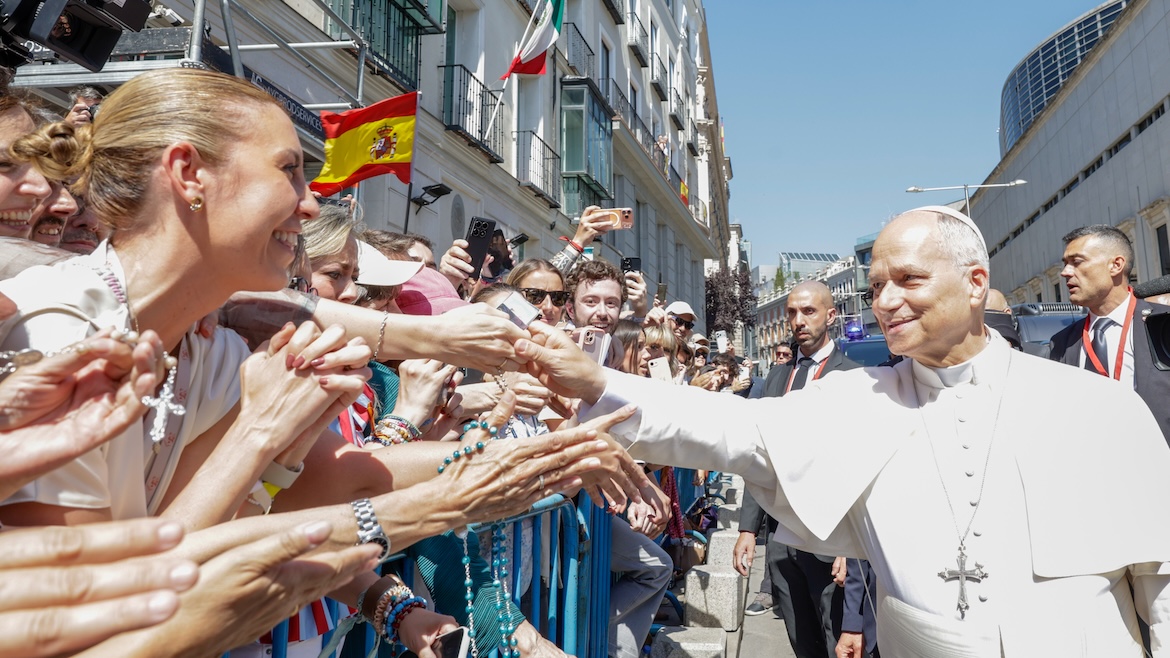 Pope Leo XIV greets the people who gathered at the entrance to Parliament on Monday 8 June. / Spanish Parliament, Congreso de los Diputados.
The media coverage of the Pope’s visit to Spain has been astonishing. Its relentless intensity is comparable only to what we see during a 'Gay Pride' week.
In both cases, it seems that the media have decided that these are universal events that everyone must support, not as a result of shared debate and reflection, but as a self-imposed assumption. Although many are not enthusiastic about 'Gay Pride', everyone feels obliged to support it. The same is true of the Pope’s visit.
All Evangelical Focus news and opinion, on your WhatsApp.
This is even more striking when we compare this laudatory coverage with that given to recent evangelical events, which were unacceptably caricatured and vilified in the media.
The media may not be religious, but they maintain a Catholic mindset in the sense of having an untouchable pantheon of saints and a list of heretics. The LGBTQI+ lobby and the Pope feature in the former category, and it will take us as long to escape the latter as it takes souls to escape purgatory.
Politicians have all tried to take advantage of the situation, claiming that their views are in line with those of the Pope.
The Pope was interested in the government's support and the government was interested in the media attention generated by his presence. Interestingly, there has been little mention of the political corruption case of former Spanish president, Rodríguez Zapatero, in recent days. Everyone's happy.
However, the Catholic Church does not quite grasp the concept of church-state separation, what we call laicidad. If your at mass, don't pretend to be in the bell tower.
It was the Pope, not Parliament, who requested to speak in Parliament. In what capacity did he do so? As head of a church? As a head of a state?
No matter how much you try to make it fit, the existence of a Vatican State and a Concordat between that state and Spain does not align with the purely spiritual nature of the Pope’s leadership.
Much of the Spanish political class does not understand laicidad either, because it is a Protestant concept that the Spanish mindset finds difficult to accept. As a Spanish writer, Pío Baroja said: “They are always following the priests: sometimes with a candle, other times with a stake”.
Pope Leo XIV's speech was very well structured, and he correctly addressed several issues of interest, such as respect for life from beginning to end, care for migrants, respect for dissent, and the promotion of dialogue. He did so with clarity and balance.
That said, it is easy to preach to politicians about what they should do when you do not have to make real decisions in real-life situations. It is a cheap way of putting yourself on a moral high ground, because you don't have to get involved in political decisions or face their consequences.
The best example of this was his criticism of rearmament in Europe, instead of engaging in dialogue. No one could applaud this more than the tyrant Putin, just as Hitler would have done on the eve of the Second World War. If Europe had followed the Pope's advice, Ukraine would now be wiped off the map, and the rest of us would be next.
But the Pope showed a significant flaw in his attempt to link the defence of freedoms with Spanish thought.
To understand the current political reality in Spain, one must delve into the formation of the Spanish collective mindset, because the harsh political and social confrontations we see today have more to do with the collective mindset than with ideologies. And this mindset in our Spain has been definitively shaped by the Church of Rome.
The imposition of a heavy-handed approach has much in common with the imposition of dogma by the religious majority. The persecution of dissidents within parties with the condemnation of heretics. The strict discipline of voting with the imposition of orthodoxy. And the silencing of the rebellious with suspension a divinis. An entire column could be written on the subject.
The Pope quoted Francisco de Vitoria. The difference between Vitoria in Spain and Roger Williams in the US lies in their respective discourses. Vitoria failed due to the intolerant Tridentine mindset in Spain, which was a hammer against heretics, whilst Williams served as a model for the formation of the world’s first democracy, which was built upon the collective Protestant mindset.
Autocracy was perpetuated in Spain, rooted in the Catholic union of throne and altar, while democracy was developed in Protestant countries through reading the Bible.
That union of throne and altar has only begun to shift very recently. If one phrase was key to the military uprising of 1936 prior to the Civil War, it was that of Spanish general Azaña: “Spain is no longer Catholic”. The clergy and a section of society could not tolerate it.
Those of us who experienced the political transition to democracy at the end of the 1970s remember that our greatest concern about the arrival of democracy was the army and the Roman Catholic Church. They imposed conditions on the Constitution, such as the specific reference to the Catholic Church in Article 16, which remains there to this day.
The Pope spoke of “freedoms”. Democratic freedoms were won in Protestant countries based on the Protestant worldview. In Catholic countries those freedoms had to be won by challenging the Catholic worldview.
When the Pope cited freedom of conscience, he forgot that the Catholic Church has been its greatest enemy for centuries.
The biggest problem this Church faces in challenging gender ideology in schools nowadays in Spain, is that it lacks the moral authority to do so: for centuries, the Roman Catholic Church in Spain imposed its own indoctrination.
Spanish secularist dogmatism is the heir of the Catholic worldview. With that same mindset, it insists that 'the majority is always right' and therefore has the right to impose its dogmas.
While the Pope is right to argue that “political pluralism should not degenerate into the permanent disparagement of one’s adversary”, the problem is that dogmatic secularism has learned to disregard minorities from the uniform Catholic mindset, which has always criticised diversity within Protestantism.
We agree with the Pope's defence of human life from the moment of conception. But every Protestant is prepared to defend it, even if they stand alone and pay the price for doing so, precisely because, for a Protestant, faith is a personal relationship with God and a personal responsibility without intermediaries. In the Catholic mindset, faith is channelled through the institution, so it is more difficult for Catholics to stand alone against the majority.
For centuries, they have been in the majority and understood that one must always side with the majority, even if one disagrees with it. This explains why former President Mariano Rajoy (Conservatives) backed down from his commitment to change the abortion law.
In the Catholic mindset, the institution takes precedence over the individual. This explains why personal freedoms still have a long way to go in Spain and why Catholics have unquestioningly accepted the dogmas now imposed by a new majority.
This is why a largely Catholic society such as Spain's has been accepting foreign dogmas without resistance and contradicting its beliefs through its actions and votes. It is a religious problem with political implications.
Much of the Pope’s speech was very good, but if he is to deliver it again, he must first rebuild his moral authority.
To do so, the Pope and the Church he leads face the challenge of reviewing their institution in light of the Word of God. Before preaching freedom of conscience and other freedoms, as well as respect for diversity, they must examine their own role in shaping a centuries-old mindset that denied those freedoms.
While it is certainly courageous to ask for forgiveness for sexual abuse, it is equally important to review the Catholic Church’s contribution to shaping the Spanish collective mindset, evaluate it, and encourage its members to do the same.
To this end, we encourage the Church of Rome to do what we Protestants have done and will continue to do: return to the Bible.
Finally, the Pope’s speech in the Spanish national Parliament also provides an opportunity for us Protestants to reflect on what our role in public life is and should be - but that, again, is a topic for another column.
Xesús Manuel Suárez, medical doctor and general secretary of the Spanish Evangelical Alliance.
[analysis]
[title] Do you see a need for this kind of journalism? [/title]
[text] Evangelical Focus is a network of many people in Europe and beyond who strive to bring a uniquely Christian perspective to the big issues of conversation.
Through news, interviews, opinion and analysis, we seek to build bridges between evangelical churches and the societies in which they live.
As a non-profit entity, the big challenge is to be sustainable, month by month. We invite you to make a difference! Join the readers who make Evangelical Focus possible.
[/text][/analysis]





Las opiniones vertidas por nuestros colaboradores se realizan a nivel personal, pudiendo coincidir o no con la postura de la dirección de Protestante Digital.


Si quieres comentar o