


Fifty years ago, on July 9, 1976, I landed in Frankfurt am Main with my family. A Lufthansa plane had flown us from Moscow to Germany. “To freedom”—as people said. My parents had been waiting for an exit permit since 1956. Now the time had finally come.
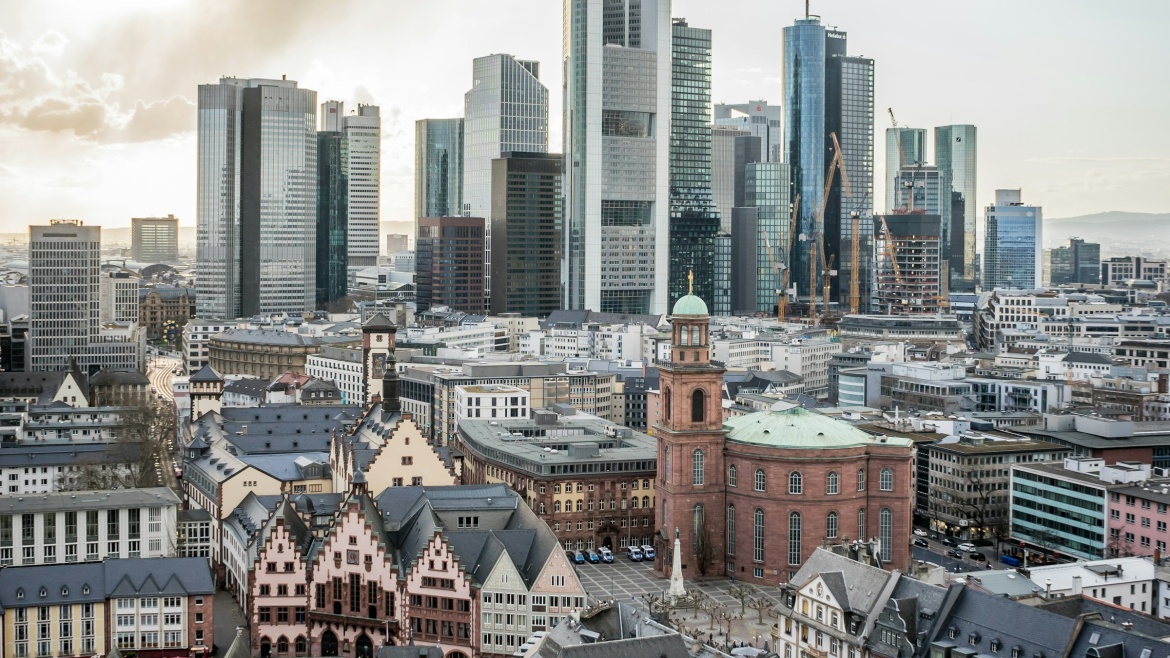 A view of Frankfurt am Main, in Germany. / Photo: [link]Leonhard Niederwimmer[/link]
On July 9, 1976, I landed in Frankfurt am Main with my family. A Lufthansa plane had flown us from Moscow to Germany. “To freedom”—as people said. My parents had been waiting for an exit permit since 1956. Now the time had finally come.
Left behind were the bitter experiences of our family’s deportation from our North Caucasus homeland to Western Siberia and Northern Kazakhstan, and the graves of relatives murdered or tortured to death by Stalin’s regime [1].
All Evangelical Focus news and opinion, on your WhatsApp.
I was 21 at the time. Just a few months earlier, I had been discharged from the Soviet military labor camp for health reasons. I had refused to serve with a weapon in the Red Army and had gone through hell—enduring humiliation and abuse [2]. Now I was sitting on a Western airplane and ordering a Coca-Cola for the first time in my life. My whole being was on edge to the extreme. What awaited us in this West that everyone praised so highly?
[destacate]The plane landed safely in Frankfurt. In just two hours, we had flown over the border between East and West, dictatorship and democracy, oppression and freedom[/destacate] My parents were looking forward to returning to their ancestral homeland. After 200 years of living in the Russian Empire and the Soviet Union, was it really still that? We had always spoken German at home, and the family adhered to German customs and traditions come what may. More than once, I’d been beaten simply because I’d spoken Russian at home yet again. But were these traditions we’d adhered to so meticulously even German anymore? Would people understand us? Would we understand the Germans? In Estonia, where we’d lived for the past 10 years, we’d bought the very most modern clothes. Was that European?
The plane landed safely in Frankfurt. In just two hours, we had flown over the border between East and West, dictatorship and democracy, oppression and freedom. Was that also the border between yesterday and today, the past and the future?
In any case, we were entering a foreign world. Frankfurt Airport shocked me with its neon signs, all the glitz and glamour of advertisements and promises, and the many smiling faces of people from all over the world who were scurrying back and forth around us like ants. It almost took my breath away [3].
I looked at my family, and it struck me just how different we were. Our supposedly state-of-the-art clothes looked drab and outdated. And you could tell just by the look on our faces—we didn’t belong here. We stood there, lost, in the waiting hall of this other world.
In the very next moment, volunteers from the German Red Cross were taking care of us. We were invited to follow them, and within a few minutes we saw them—the other resettlers, with exhausted and slightly bewildered expressions, dressed much like us and yet somehow relieved to have arrived. I looked around, my eyes glued to the neon signs and the people rushing about me, heading somewhere. We were there in the land of our German forfathers. Was this a homecoming, or would it turn out to be more of a trial?
Fifty years have passed since then—that’s a long time. It makes sense to take stock. During those years, I studied in Germany, Belgium, the U.S., and South Africa; married a German woman; had three children and watched them grow up; founded churches and mission organizations; and was active in pastoral and evangelistic work. How do I view Germany and the West today, after 50 years? Was that a homecoming, or was it more of a trial?
[destacate]I notice how our societies are falling apart as a collective and are even being literally eroded by an ever-increasing individualism[/destacate] I know that as a repatriate from the Soviet Union, I’m often accused of being different—just as in my own widely acclaimed book, Repatriates Are Different [4]. I, too, have my own perspective on the developments of the past decades. My Eastern European background, my studies in the U.S. and South Africa, and my many—very many—trips and ministries in well over a hundred countries have shaped this perspective. But perhaps it is precisely this somewhat different perspective that is interesting and helpful.
So how do I view the West after 50 years of living and working here? Several observations come to mind.
First, I notice how our societies are falling apart as a collective and are even being literally eroded by an ever-increasing individualism. Under the guise of democracy, truth and faith are relativized, and one’s own opinion is posited as the ultimate criterion for authenticity. The community, the collective, on the other hand, is viewed as a gray mass of indifferent citizens posing a threat.
But with the collective, shared values and a culture shaped over centuries—which ultimately laid the foundation for our prosperity—disappear from society. Cultural anthropology teaches us, that this culture is the true force that enables us to cope with life [5]. What, then, should the individual be able to rely on in a world where only the individual’s momentary private opinion counts?
Amid the sheer volume of opinions, one soon can no longer see the way forward. Is it any wonder that loneliness is becoming one of the main causes of depression and other mental disorders in society? Is a person who is left to fend for themselves still human in the end? Or do they instead wither away in their self-built “prison of the self”? Will the self-centered individuals of the West be able to shape the world in any way beyond the destructive wave of egoism? I fear not. Individualism, however, comes up with new gender variations every day. They claim to be for people, but they’re all at odds with one another. And they don’t promote true humanity. If anything, they banish it to a corner reserved for the “weary and burdened.”
And fourth, I observe with deep concern how right-wing, at times extremely dictatorial tendencies are flaring up everywhere in the West. The Trumps of this world are multiplying at an astonishing rate. They seem to offer our utterly unsettled contemporaries an anchor to which one might still cling, even as everything else is being torn away.
[destacate]I fled that atheistic country back then. Here in the West, politicians were sworn in with the Bible in hand to serve their country with loyalty and devotion to God. But we are now worlds away from that[/destacate] As someone who fled the Soviet dictatorship 50 years ago, I can only issue a warning. The new kings are no saviors; like Donald Trump, they always think first of lining their own pockets. What happens to the rest of humanity in the process is of little consequence. And ultimately, this is why the looming climate catastrophe, global warming, and other threats to the future are denied, and wars are instigated—wars that are then sold as peace initiatives. The fact that thousands of innocent people die in the process is apparently of little concern.
And then I am amazed at how godless the West has become over the past 50 years. I fled that atheistic country back then. Here in the West, politicians were sworn in with the Bible in hand to serve their country with loyalty and devotion to God. But we are now worlds away from that. It is not God, but selfish man who has taken charge everywhere. And it is not the Bible as the foundation of truth, but the spirit of the times that dictates what should be right and just.
Consequently, it is not Russia and their Soviet satilites, but the Western countries, that are now the world’s atheistic societies. In Russia back then, the saying went, “Without God, the path is wider.” But where that path led, was kept hidden from the masses. Today we know—it led to ruin for millions of people! Is the West simply repeating the same folly all over again?!
There’s no question that the growing decadence of the Christian churches in the West is, in this regard, the saddest development of the last few decades for me. What a time of evangelism and spiritual renewal we experienced when we arrived in Germany in 1976. It was the era of Billy Graham and Luis Palau, the era of the Charismatic Revival and an intense expansion of global missions. What remains of all that today? If anything, this revival is taking place in the countries of the Global South.
In the West, by contrast, the church is in decline. In Germany alone, hundreds of thousands leave the church every year. And in other Western countries, the situation is by no means better.
Isn’t social decay also a consequence of the church’s decline? Isn’t the warning voice of God dying along with it? And is that why the masses are crying out for a new political savior—because they have lost sight of Jesus Christ? I think so.
[destacate]It is high time to reflect on the foundations of our Western democracy. It is not too late to repent, but we must repent if we want to live in peace and prosperity[/destacate] So where are we headed in Germany and in the West as a whole? Toward a bright future? Who still believes that? I certainly don’t. The daily clamor of war, the hundreds of thousands of bankruptcies, and a growing army of unemployed and lonely people as well as a stream of refugees all around the world, tell a different story.
It is high time to reflect on the foundations of our Western democracy. And these do not lie in European humanism, as is so often mistakenly claimed today, but in faith in God, who created life on earth and sent His Son, Jesus Christ, to save us humans from destruction (John 3:16). No, it is not too late to repent, but we must repent if we want to live in peace and prosperity.
No, I haven't regretted coming to the West in 1976. But over the years, I've lost all my illusions, and I can only hope that God will be merciful to us as well. What we need is a spiritual revival.
Johannes Reimer, Professor Emeritus of Missiology and an active retiree.
1. See more in: Johannes Reimer: Opa Hans erzählt. Die Geschichte meiner Eltern. (Bergneustadt: Selbstverlag, 2022).
2. Johannes Reimer: Liberty in Confinement. (Winnipeg: Kindred 2000).
3. See more about the emotions running throug my body in: Johannes Reimer: Rückkehr ins Land der Väter. (Basel: Brunnen Verlag, 2008).
4. Johannes Reimer: Aussiedler sind anders. Russlanddeutsche unter uns. (Kassel: Onken Verlag 1989).
5. See, for instance: Lothar Käser: Fremde Kulturen. Eine Einführung in die Ethnologie. (Bad Liebenzell: VLM, 1997), 37.
[analysis]
[title] Do you see a need for this kind of journalism? [/title]
[text] Evangelical Focus is a network of many people in Europe and beyond who strive to bring a uniquely Christian perspective to the big issues of conversation.
Through news, interviews, opinion and analysis, we seek to build bridges between evangelical churches and the societies in which they live.
As a non-profit entity, the big challenge is to be sustainable, month by month. We invite you to make a difference! Join the readers who make Evangelical Focus possible.
[/text][/analysis]






Las opiniones vertidas por nuestros colaboradores se realizan a nivel personal, pudiendo coincidir o no con la postura de la dirección de Protestante Digital.


Si quieres comentar o