


Europe would not simply sanction a private individual who supports Putin in the war, but the most important figure of the Russian Orthodox Church itself. Is that what we want?
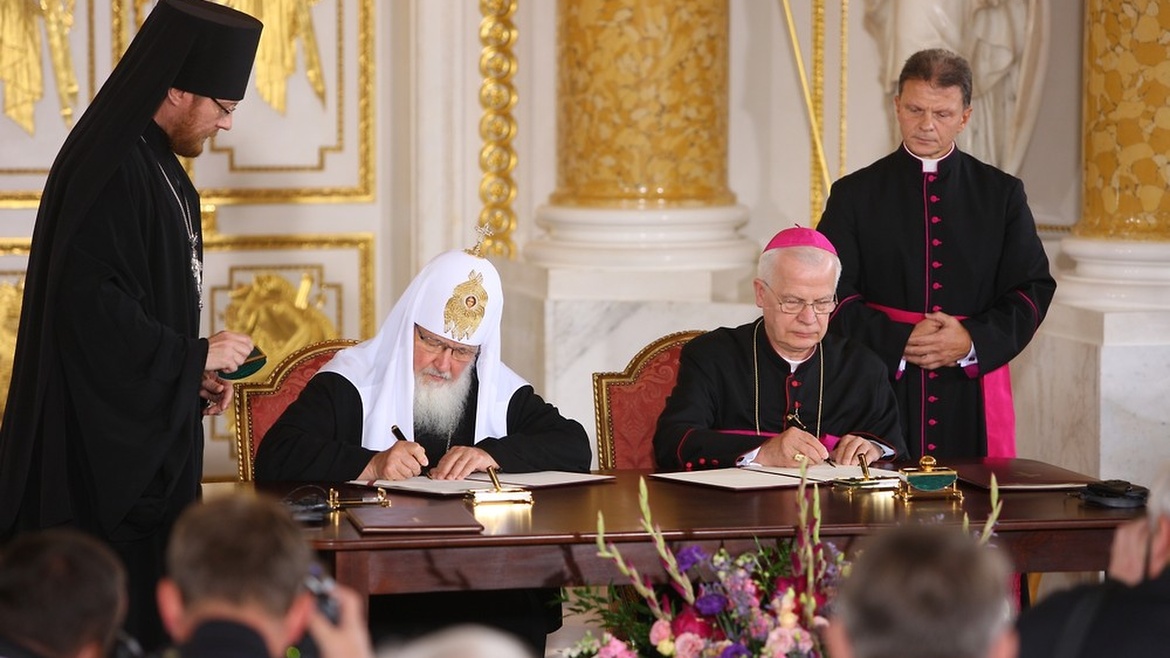 Kirill and Roman Catholic archbishop Józef Michalik signing a declaration in Warsaw, Poland (2012). / Photo: [link]Senate of the Republic of Poland [/link].
Once again, Europe is discussing the next package of sanctions against Putin’s Russia. For those keeping count—that’s the 21st! And once again, the sanctions include measures targeting several influential Russian politicians and business leaders. Unsurprisingly, the proposals also include, among others, the supreme spiritual leader of the Russian Orthodox Church (ROC), Patriarch Kirill I. And this is not the first time.
All Evangelical Focus news and opinion, on your WhatsApp.
However, no sanctions were imposed on the patriarch, who is highly controversial both at home and abroad. While most European countries are clearly in favor of punishing Putin’s closest supporter, others—including Bulgaria—are more skeptical and warn against sanctioning one of the most important spiritual leaders in global Orthodoxy.
What are the arguments for and against?
Any action taken against the Russian patriarch must take into account the consequences that such an act entails. Patriarch Kirill I is not simply an individual like many other public figures in Russia. He is the head of the Russian Orthodox Church and thus, in every respect, its embodiment.
[destacate]It is not surprising that Kirill I endorses Putin’s bellicose actions and blesses his army on the front lines. He is merely following the constitution of his Church[/destacate] Punishing this supreme authority will consequently be viewed as punishing the Church. A separation of office and person, as is customary in most Western churches, is not provided for in the Byzantine constitution of the Russian Orthodox Church.
Furthermore, the Patriarch is integrated into the Byzantine symphony between State and Church. Since the time of Kirill I, the Russian Orthodox Church has regarded itself as the State Church. Within this symphony, the head of the Church is obligated to support the head of State, and the head of State, in turn, is obligated to support the head of the Church. It is therefore hardly surprising that Kirill I endorses President Putin’s bellicose actions and blesses him and his army on the front lines. In doing so, he is merely following the constitution of his Church.
Admittedly, in the eyes of the democratic West, he—like his president—violates international law, fuels war rhetoric, and can certainly be described as one of the most important warmongers. This would justify sanctions against him.
But would such sanctions be justified against all Orthodox Russians? Or all citizens of Russia? Certainly not. Yet this is precisely how the members of the ROC must understand the punishment of their spiritual leader. Here, one is not simply sanctioning a private individual, but the most important figure of the Church itself. Is that what we want?
At this point, one can draw a comparison with the sanctioning of other public institutions, such as the country’s Olympic Committee or football association (FIFA).
Is it justified to place every athlete under general suspicion simply because these institutions are being sanctioned? After all, it is not institutions that are excluded from competitions, but first and foremost the athletes. And the vast majority of them do not identify with their president’s war. Just as the majority of the Russian Orthodox Church does not.
Sanctioning their patriarch is, in every respect, tantamount to severing all ties with Christians in democratic countries. And why would our societies want such a severance?
There’s no question that Patriarch Kirill I deserves to be isolated by the West for his support of the “holy war” he has proclaimed. But his actions, however negative they may appear to us, are legitimate acts of a church leader acting within the framework of the Byzantine church-state symphony. The fact that, much like Vladimir Putin, he appears to be deeply convinced of his own actions—and has even enshrined them in the fundamental tenets of his “Russki Mir” doctrine—only makes the suspicion all the more pressing.
[destacate] In some parts of Africa, Putin and Kirill I are even revered as heroes because they dared to stand up to “Western imperialism”[/destacate]Whether his church will obediently follow him in this can be safely doubted. Rather, a large majority is for the time being waiting to see what the “special operations” of their leaders will bring.
And quite a few are also voicing their protest. Hundreds of thousands have already left Russia since the war began, and quite a few have left the Church.
And yet Kirill I is the public face of the Church. Sanctions against him could have negative consequences for the Russian people’s attitude toward the West. A more peaceful dialogue would be the better course of action. There is no need to gloss over the regime’s crimes when reaching out to the people of the country.
The future of our relationship may not depend on Putin or Kirill, but it certainly depends on the relationship between our peoples and churches. That is why it would be wise to consider how to appeal to the head of the Russian Orthodox Church to see reason.
Sanctions, in any case, will not do the trick.
In addition to the potential isolation of Russian Orthodox Christians resulting from sanctions against their patriarch, there is also a sympathetic attitude on the part of no few members of the World Council of Churches (WCC) toward the Russian Orthodox Church and even toward Putin’s policies.
In some parts of Africa, Putin and Kirill I are even revered as heroes because they dared to stand up to “Western imperialism.”
Proponents of the idea of expelling the Russian Orthodox Church from the WCC had to abandon it very quickly, primarily due to the reaction of other churches, especially in the Global South. There, the focus is above all on dialogue. Jeopardizing this dialogue through punitive measures could quickly provoke a negative reaction from churches sympathetic to Russia. And surely no one wants that.
In conclusion, sanctions against Kirill I could have far greater consequences than European politicians imagine.
On the internet, the arguments in favor of sanctioning the high-ranking Russian clergyman are repeatedly bolstered by claims that Kirill I once collaborated with the Soviet KGB, leads a very dissolute lifestyle, and has amassed a large personal fortune over the years. He is said to own a number of properties and even to own a spacious chalet in Switzerland. Most of this information, however, consists of unsubstantiated speculation. In any case, I found no concrete evidence in the countless publications.
If such evidence exists, it should be presented to the public in light of serious measures such as sanctions. It could potentially lead to the patriarch’s removal from the Russian Orthodox Church, and his influence on Russian politics would then be considerably less than it is today. Spreading rumors or even using them as “compelling arguments” for sanctions is, in any case, wrong.
Johannes Reimer, professor of missiology at the University of South Africa (UNISA) and autor of numberous publications on the church in the Soviet Union and Russia.
1. Sven Wagner: EU-Sanktionen gegen Russisch-Orthodoxe Kirche und Patriarch Kirill? In: Nordish.Info of 11. May 2026, https://www.nordisch.info/panorama/eu-sanktionen-gegen-russisch-orthodoxe-kirche-und-patriarch-kirill/ (accessed: 17.06.2026).
2. Ökumenischer Rat der Kirchen: Osteuropa-Expertin: Russische Kirche in Weltkirchenrat nicht isoliert. In: https://www.sonntagsblatt.de/artikel/kirche/osteuropa-expertin-russische-kirche-weltkirchenrat-nicht-isoliert (17.06.2026).
3. See among others: Das geheime Leben des Kirchenfürsten: Kyrill I. war KGB-Spion. In Sonntagszeitung vom 9.02.2023, https://www.jesus.de/nachrichten-themen/orthodoxer-patriarch-kyrill-i-war-kgb-spion/ (17.06.2026).
[analysis]
[title] Do you see a need for this kind of journalism? [/title]
[text] Evangelical Focus is a network of many people in Europe and beyond who strive to bring a uniquely Christian perspective to the big issues of conversation.
Through news, interviews, opinion and analysis, we seek to build bridges between evangelical churches and the societies in which they live.
As a non-profit entity, the big challenge is to be sustainable, month by month. We invite you to make a difference! Join the readers who make Evangelical Focus possible.
[/text][/analysis]






Las opiniones vertidas por nuestros colaboradores se realizan a nivel personal, pudiendo coincidir o no con la postura de la dirección de Protestante Digital.


Si quieres comentar o