


Anabaptists celebrate their 500th anniversary in 2025. We spoke with Spanish pastor Agustín Melguizo about the past, present and future of this movement.
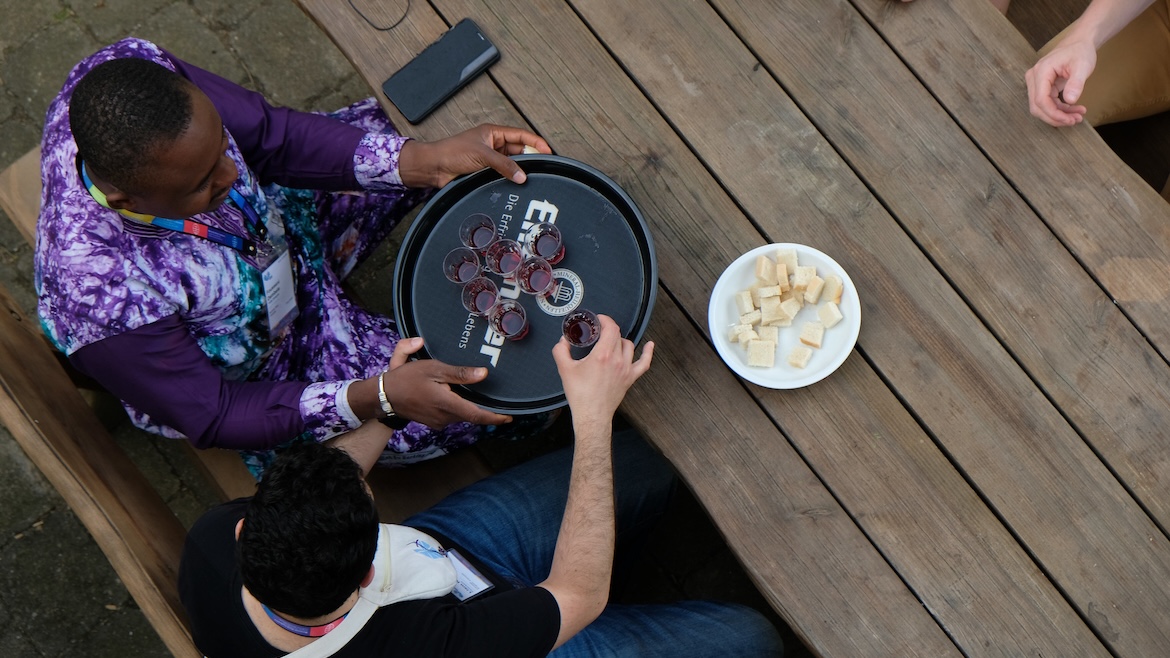 Sharing communion at a Mennonite World Conference meeting in 2025./ Flickr, CMM, CC 2.0
Anabaptism, also known as the Mennonite movement, began in Europe 500 years ago when the first adult baptisms took place in Zurich.
Though harshly persecuted by the authorities and the clergy, they survived and spread throughout the continent, forming lively and vibrant communities and influencing other Christian movements with their interpretation of the Bible.
In Spain, the Inquisition's severe repression of any Reformation movement prevented Anabaptism from truly taking root until the 20th century.
All Evangelical Focus news and opinion, on your WhatsApp.
One of the most vibrant Anabaptist communities was established in the north-eastern Spanish city of Burgos, and continues its work of Christian witness and service today.
Spanish news website, Protestante Digital, spoke with Agustín Melguizo, pastor of the Evangelical United Anabaptist Communities Church in Burgos, about the arrival of Anabaptism in the country, its historical development, social commitment and the challenges it faces today.
Question. The Anabaptist movement began in Zurich 500 years ago. How did the movement reach Spain?
Answer. The Reformist movements that emerged in Spain in the 16th century were always clandestine due to the persecution they suffered, which makes it difficult to know if any of them included people who sympathised with Anabaptist ideas.
Anabaptism was not an organised movement. It emerged almost simultaneously in places such as Zurich and Holland, with people who shared similar ideas without having previously agreed to do so.
It is possible that individuals who arrived in Spain from territories where the Reformation was developing had had contact with European Anabaptists and brought those ideas to Spain. However, there are no clear records or sufficient research on the subject. For verified data, we must go to the 20th century.
We know, because it is documented, that Mennonite aid workers were sent by the Mennonite Committee for Humanitarian Aid during the Civil War of Spain.
They stayed in this country between 1937 and 1939, providing breakfasts for refugee children and distributing food, soap, clothing, and footwear, primarily in the regions of Murcia, Extremadura, Castilla-La Mancha, and Andalusia.
One of these aid workers wrote the book Peregrinaje de servicio (Pilgrimage of Service), which offers a valuable portrait of the Civil War in the areas where they worked and is available on our website (in Spanish).
Later, in 1975, missionaries Juan and Bonnie Driver arrived in Spain and settled in Madrid. Juan travelled to many churches to provide training and made a significant impact on a generation of young people, who still remember him fondly today.
His book Militantes para un mundo nuevo (Militants for a New World) became a benchmark text. Other missionaries followed, such as Connie and Dionisio Byler, and two main Anabaptist centres were established in Barcelona and Burgos.
Q. You are a pastor at the Evangelical United Anabaptist Communities Church in Burgos. How does the history of your church relate to religious freedom in Spain?
A. In the mid-1970s, an important youth movement emerged in Burgos, with two main focuses: the so-called 'community movement' and a Baptist church founded by American missionaries. Both movements coexisted, sometimes interacting more and sometimes less, but always in contact.
The community movement developed mainly within the Catholic Church, although it also had many connections with evangelical churches. Those were years of taking to the streets with music, theatre, and other cultural expressions, and many people were open to the gospel.
When that movement began to disintegrate, Mennonite missionaries Connie and Dionisio Byler arrived and gathered what remained of those communities, leading to the creation of the Mennonite community of Burgos.
At the same time, the Baptist Church, under the leadership of Roberto and Susana Jobe, became known in Burgos as the Church of San Francisco. Both processes coexisted and had a profound impact on the evangelical history of the city.
Q. What is the current situation of your local church?
A. Sixteen years ago, our church merged with another to form a single community. The Burgos City Council granted us a plot of land in a new residential area where we built our current church.
Although we are mostly Spanish, the church reflects the diversity of society, with people of different nationalities and of all ages living together, including grandparents, parents and grandchildren.
We continue to focus on culture as a bridge to society. Young people are promoting initiatives such as the Baliza platform, which unites faith and culture. We have also restarted the Origen gathering: a weekend retreat that brings together young people from all over Spain.
Furthermore, we run chaplaincies in prisons and hospitals, and we aim to be an accessible, understandable and welcoming church for everyone within the Spanish cultural context.
Q. What distinguishes Anabaptist communities from other evangelical denominations?
A. We are more than just a denomination; we are a fellowship of diverse churches united by Anabaptist inspiration and the vision of free churches.
We share many principles with other evangelical groups, such as believer's baptism, the separation of church and state, and voluntary participation in the Christian community.
Perhaps one of our most distinctive features is our commitment to non-violence in conflict resolution. While the differences with other churches are sometimes only nuances, we always seek to be faithful to the Gospel, even when that has consequences. Such faithfulness is part of the historical DNA of Anabaptism.
Q. When people talk about Anabaptists or Mennonites, they often think of isolated communities like the Amish. Does this lead to prejudice in Spain?
A. Not really. There are no Amish communities in Spain, so we are not usually associated with that image. Furthermore, we do not place much importance on denominational labels. Many people come to church without knowing exactly who we are, and that is not a problem.
We interact normally with other churches and denominations, collaborating and working together. Our main interest lies in the Kingdom of God, rather than defending a denominational identity. That is why we usually present ourselves simply as an evangelical church.
Q. Social action is a hallmark of Anabaptism. How does this take shape in Spain?
A. Much of the social action carried out by churches is not always visible or institutionalised, but there is a real commitment to the community. In our case, we have the NGO La Casa Grande de Burgos (The Big House of Burgos), which is well known in Burgos and Castile and León.
We have been working in the Republic of Benin for 25 years. We started with a sponsorship programme and today we have a foster home, a primary school, a secondary school and several community programmes.
For the past five years, in collaboration with the Burgos City Council, we have been developing a waste collection and treatment project that generates energy, alternative fuels and compost for agriculture.
Q. Culture is also very important to you, with your work with the Francisco de Enzinas Cultural Association. Why Francisco de Enzinas?
A. Francisco de Enzinas was a Burgos native and the first person to translate the New Testament from Greek into Spanish. He is a key figure in Spanish cultural and literary history, although he was little known for centuries because of his Protestant beliefs.
In 2017, we organised a conference at the University of Burgos with national and international historians to recognise his legacy. We share his passion for the Word, both as the Bible and as a means of communication.
We have the Francisco de Enzinas lecture hall in our church, and thanks to an initiative accepted by the City Council, a street in Burgos now bears his name.
Q. What are the main challenges facing Anabaptism today, in Spain and worldwide?
A. Each generation faces different pressures that can dilute the gospel. Our challenge is to pass on to the next generation a faith understood as lifelong discipleship, lived radically in community.
The centre of the Anabaptist movement is no longer in Europe or the United States, but in Africa, Asia, and Latin America. In Spain, for instance, the fastest-growing group is Amor Viviente (Living Love), which originally comes from Central America.
The challenge is how to live a radical gospel in very diverse cultural contexts while remaining faithful to the message of Jesus.
[analysis]
[title]Join us to make EF sustainable[/title]
[photo][/photo]
[text]At Evangelical Focus, we have a sustainability challenge ahead. We invite you to join those across Europe and beyond who are committed with our mission. Together, we will ensure the continuity of Evangelical Focus and our Spanish partner Protestante Digital in 2025.
Learn all about our #TogetherInThisMission initiative here (English).
[/text][/analysis]





Las opiniones vertidas por nuestros colaboradores se realizan a nivel personal, pudiendo coincidir o no con la postura de la dirección de Protestante Digital.


Si quieres comentar o