


The World Humanoid Games 2026 were entertaining, but they also revealed deeper cultural currents: the concentration of technological power, the acceleration of autonomous warfare, and the loneliness that makes artificial companionship seem plausible.
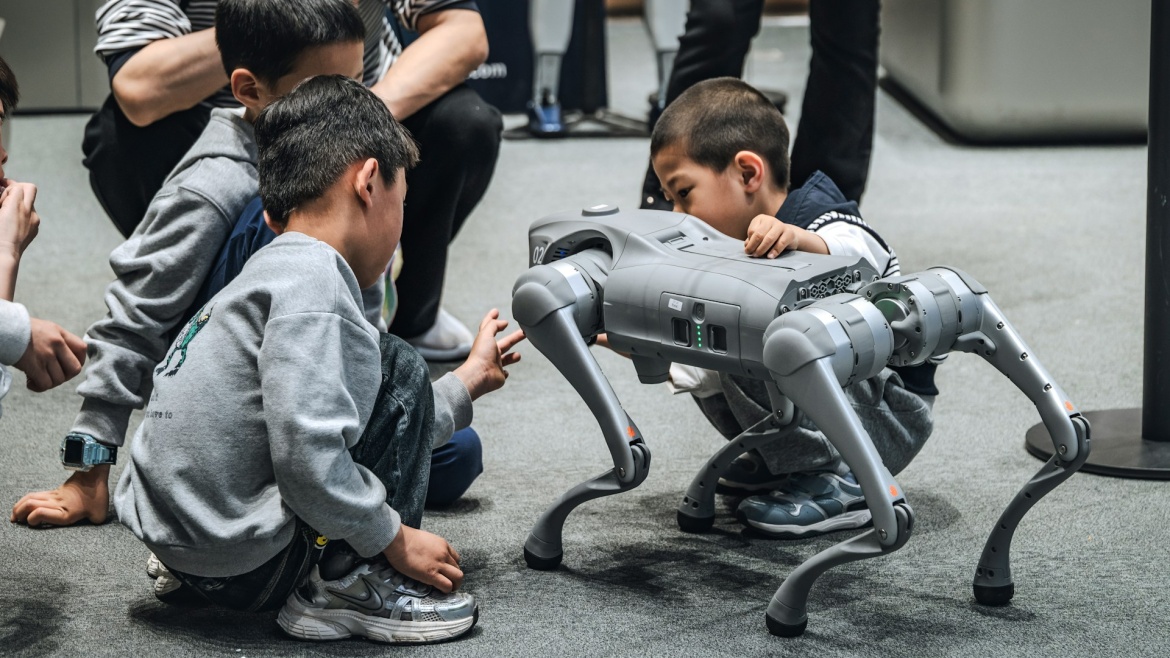 Children in China play with robots. / Photo: [link]Jacky Yu[/link]
I am sure many of you, like me, watched with a mixture of amazement and amusement scenes from the recent World Humanoid Games in Beijing. Amazement at the sophistication of the robots and amusement at their limitations.
The contradiction was captured most powerfully in the fact that one robot crossed the finish line of a 100m sprint ahead of Usain Bolt’s record, then fell over and crashed (by design) into a barrier in a very non-Bolt fashion! [1]
It seems more effort has gone into getting the machines up to speed than slowing them down after the finish line.
All Evangelical Focus news and opinion, on your WhatsApp
More than 2000 robots in 666 teams (one assumes the number is coincidental!) from 16 countries competed in 51 events at the Games. [2]
As well as Bolt’s record, the 400m sprint record was also beaten and crashing into a barrier after a sprint was far from the worst malfunction. As one article says, “In their attempts to run, kick box, and ultimately outdo humans, futuristic humanoid machines hurtled into barriers, fell head over heels and spontaneously combusted”. [3]
The Games raise some significant questions. Mingled with our amusement and amazement is a third feeling: anxiety. These machines provoke not only wonder but a subtle disquiet about the direction of technological power. Three areas of potential concern strike me.
First, the Games showcased China’s dominance of the field
The Games have only been held twice – both times in China. Of the 666 competing teams, 641 (96.2%) from China. Both record-breaking robots were Chinese. This is just one of many signs that China has become, and will continue to grow as, a major world power.
The distrust of China by Western powers is a frequent feature of the news, but even aside from those concerns the idea that any nation should be so dominant in any industry is concerning.
The same could be said for the dominance of the USA in artificial intelligence and internet services.
Second, the Games highlighted concerns about robot soldiers
More than one person has commented to me about the army-like appearance of the robots parading in the opening ceremony, wondering whether robot soldiers might be developed. The reality is that robots are already engaged in warfare. Not robots in human shape like those at the Games, but autonomous drones and unmanned ground vehicles. [4]
This week the United Nations and Red Cross jointly issued an urgent appeal for international agreement on rules to govern lethal autonomous weapons. [5]
The fact that artificial intelligence can make a decision to kill people is deeply troubling and the fact that technology has overtaken rule making is concerning.
Third, the Games raise questions for society
Given that most robots are designed to maximise effectiveness at a single task, which generally means they are not shaped like human beings, we might wonder why companies are also putting so much money into creating humanoid robots.
The obvious answer would seem to be that there is expected to be a significant market for companion robots, who can offer friendship, fulfil caring tasks, and offer sexual satisfaction.
Humanoid robots are a staple of science fiction, both humorous – think Kryton in the long running sci-fi sitcom Red Dwarf or Linda in the BBC’s recent Ann Droid – and serious – such as Commander Data in Star Trek: The Next Generation to touching and thought-provoking depictions by Robin Williams in Bicentennial Man (1999) and Haley Joel Osment in AI: Artificial Intelligence (2001).
But now it seems humanoid robots may soon become the stuff of science fact. The questions for society are many.
Why do we have a society in which the idea of companion humanoid robots seems plausible and where they could have a market beyond the niche few? Why are so many people living alone and lonely?
Can a robot – however lifelike – ever substitute for a loving friend or family member? The plausibility of companion robots is not a technological question but a sociological one: what kind of society produces such demand?
Christians may have a deeper question: if our deepest and most satisfying relationship of all is found in communion with God, what does the idea of companionship with robots reveal about the spiritual condition of our society?
Ethical questions also abound, both about the future of Artificial Intelligence (especially its safety, whether it could ever achieve human-like sentience, whether it might become a threat to human life, and whether it will replace too many human jobs) and about the use of such great resources (money, power and rare earth elements) in robots when many people globally live in poverty.
This is not the time or place to explore such questions, although I will include links below to resources from Christianity in Society that relate to these themes and I suspect I will return to some of them in future.
In this article, I simply want to highlight the issues and to offer three suggestions about how Christians may respond.
Firstly, as ever, we should pray
When anxiety about the future rises, we must turn to the Lord who is sovereign over history and holds our future in His hand. When we are considering purchases and thinking about our own use of AI, we need wisdom. When we have questions about the healthiness of our society, we need the Lord to guide us in our response. We must pray too that world leaders will heed the warnings about autonomous weapons and the implications of AI for jobs.
Secondly, we should set limits on our own use of AI
There are harmless and legitimate uses – as a research aid, summariser, proof-reader, or editor – and ways of engaging that are less healthy – especially if it becomes a trusted adviser on personal issues or a source of comfort when we need a friend.
Thirdly, we should invest in friendships
There is no substitute for a friend who will stick with you closer than a brother (Proverbs 18:24). Someone who will be with you through thick or thin, to listen and to advise, and even to challenge you when you are wrong. To be such a friend to people is a wonderful thing. Through friendships we can share the truth and love of Christ with Christians and non-Christians alike. The challenge is that this takes time – our most precious commodity – but the rewards and eternal potential are immense.
The World Humanoid Games were entertaining, but they also revealed deeper cultural currents: the concentration of technological power, the acceleration of autonomous warfare, and the loneliness that makes artificial companionship seem plausible. Christians need not fear these developments, because God is sovereign over history. But neither should we be naïve. By praying for wisdom, setting healthy limits on our own use of AI, and investing deeply in real human friendships, we can embody a better way that honours the dignity of persons made in the image of God.
As Christians, we need not fear the robots because God is sovereign, but nor should we flirt with them because the dangers are real. Instead, we can be the friend to someone that no robot can ever truly be and also help others to find their greatest Friend in Christ.
Paul Coulter, author, executive director of the Centre for Christianity in Society in Northern Ireland. This article was first published on the author's blog, Connected Christianity. If you would like to be informed when the Christian Leadership Integrity Commitments are released, please subscribe to this blog.
1. https://www.bbc.co.uk/news/videos/cnvlyqlql33o
2. https://www.reuters.com/world/asia-pacific/robots-can-outrun-humans-can-they-plug-cable-2026-08-23/
5. https://news.un.org/en/story/2026/08/1168196
[analysis]
[title] Do you see a need for this kind of journalism? [/title]
[text] Evangelical Focus is a network of many people in Europe and beyond who strive to bring a uniquely Christian perspective to the big issues of conversation.
Through news, interviews, opinion and analysis, we seek to build bridges between evangelical churches and the societies in which they live.
As a non-profit entity, the big challenge is to be sustainable, month by month. We invite you to make a difference! Join the readers who make Evangelical Focus possible.
[/text][/analysis]






Las opiniones vertidas por nuestros colaboradores se realizan a nivel personal, pudiendo coincidir o no con la postura de la dirección de Protestante Digital.


Si quieres comentar o