


Voices have identified the Russian House in Germany as a hub for Putin’s propaganda. But is that really so surprising? Are the Goethe Institutes, which represent German culture and language in Russia absolutely neutral?
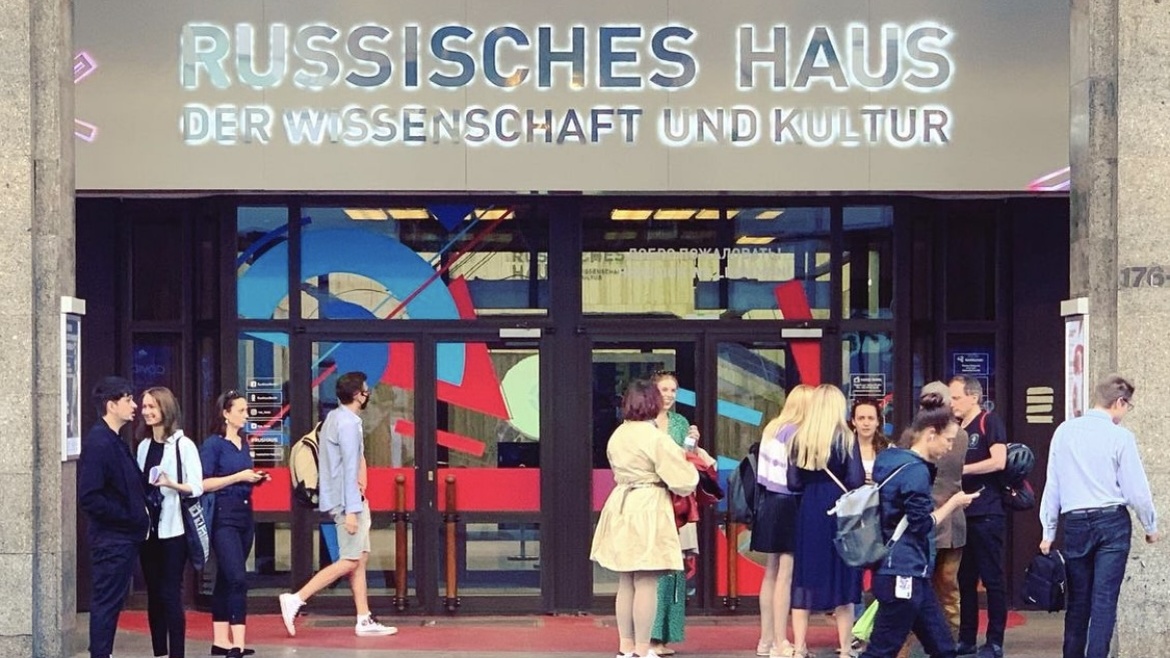 The Russian House in Berlin, Germany, in a picture of 2021. / Photo: [link]Yuri [/link], Wikipedia, CCBYSA 4.0
In the West, the Russian government’s acts of provocation and sabotage on the territory of the European Union are referred to as “hybrid warfare”.
For example, drones threaten airspace, as was recently the case at Leipzig Airport in Germany. The drones were allegedly equipped with highly explosive material. A culprit was quickly identified—Russia. Thankfully, no one was injured as a result of the provocation. After days of investigation, the German government also named Russia as the perpetrator and responded with severe penalties: The Russian House in Berlin and the Consulate of the Russian Federation in Bonn were closed.
All Evangelical Focus news and opinion, on your WhatsApp
The response from Moscow wasn’t long in coming—the Russians are now closing the German Goethe Institutes in St. Petersburg, Novosibirsk, and Moscow [2].
For years, various German media outlets have accused the Russian House of being a center of Russian propaganda and espionage. In practice, Russian language and culture were taught and presented there. Much like at the German Goethe Institutes in Russia. Now these cultural institutions are being closed under the guise of cultural activities, each portrayed as an attack on the respective country.
Does that make sense? Do these institutions really pose such a threat that they can be accused of playing a role in hybrid warfare? Do we really need to fear the Russian language and culture—and the associated propaganda promoting the Russian way of life? Can there ultimately be such a thing as ideology-free language and culture?
There’s no question that our language has power and our tongue can do harm. Even the Apostle James clearly pointed out the dangers of a loose tongue (James 3:5–6). More than once, irresponsible speech has triggered wars and conjured up the threat of war in this world. It would therefore be unwise to downplay the dangers that cultural centers can potentially pose.
On the other hand, it is language that we use to form and strengthen friendships and to foster reconciliation and understanding. Without mutual knowledge of language and culture, misunderstandings become commonplace, and these then almost automatically trigger conflicts—even wars. We humans are therefore well advised to get to know one another, to immerse ourselves in each other’s cultures, and to learn each other’s languages so that we can communicate peacefully. Careful consideration is therefore necessary when governments deprive their respective populations of the opportunity to learn the languages and cultures of others.
The German government’s decision to close the Russian House in Berlin—and thereby “slightly” escalate the conflict with Russia—may be understandable, but one wonders whether the government really can’t think of anything more effective than this. Are cultural understanding and language instruction really such a dangerous part of hybrid warfare that this is where action must be taken?
Admittedly, the voices that have identified the Russian House as a hub for Putin’s propaganda are loud. But is that really so surprising? Are the Goethe Institutes, which represent German culture and language in Russia, truly absolutely neutral? Is it even possible to convey a country’s culture in an ideologically neutral guise when worldview is an integral part of culture itself? I doubt it. Our institutes are the best proof of the impossibility of such an endeavor.
But when we Europeans package our individualism, gender ideology, and other excesses of the so-called democratic world into cultural offerings, it seems absolutely normal and is even regarded as a given of democracy; yet when states like Russia imbue their culture with ideology, it is labeled hybrid warfare. Where is the logic in that?
There’s no question that the world around us is in turmoil as it hasn’t been in a long time. Once again, weapons are speaking in Europe. Once again, innocent people—including children and women—are dying every day. There is no justification for the war in Ukraine. And as long as weapons do the talking and nations rely on their military might as the main argument for peaceful coexistence, the situation in Europe will not change—but will instead become increasingly tense.
Peace is not conjured up by weapons, but by people who talk to one another, who negotiate honestly, and who strive for peace and understanding through words.
These qualities should be fostered by institutions such as the Russian House in Berlin or the Goethe-Institutes in St. Petersburg, Moscow, and Novosibirsk. Closing them down ultimately means depriving ourselves of the most important instrument of understanding. No, the closure of the Russian House in Berlin is not a “minor” de-escalation measure by the German government, but rather a unreasonable step. And the Russians’ mirror reaction—closing the Goethe Institutes—is not much better. Without knowledge of language and culture, there will be no mutual understanding. Especially in times of war, we should take this principle to heart.
The people of Europe—and that includes Russia—long for peace. This is especially true for the Ukrainians. They need our help and our peace mediation far more than they need even more weapons and money for the military and their arms production. Any escalation of the conflict worsens, first and foremost, their living conditions.
My opponents will argue at this point that it wasn’t us who devised hybrid warfare, that it isn’t us who are flying drones over our airports and sabotaging infrastructure—but rather the Russians. Really? But then why are there countless components from Western military production found in Russian weapons? How, then, are the utterly implausible “Ukrainian” drone attacks on industrial facilities far beyond the Urals even possible? Where did the Ukrainians acquire such capabilities? Or are these, in the end, also acts of hybrid warfare carried out by recruited Russian citizens? And who recruited them?
The situation is really not as simple as our Western press paints it. It takes informed ears and the appropriate cultural sensitivity to read and hear between the lines.
There’s no question that every war—including hybrid warfare—is utterly terrible and must be opposed, no matter where it takes place, whether in Western Europe or Russia. We should finally talk about this—and do so peacefully. Ultimately, only mutual understanding can lead to peace.
Johannes Reimer, Professor Emeritus of Missiology and former head of the Department of Public Engagement at the World Evangelical Alliance (WEA).
1. Sarah Kohler: Explosive Drone at Leipzig/Halle Airport: German Government Closes the Russian House and Consulate General in Bonn. In: Die Zeit. September 1, 2026, ISSN 0044-2070 (zeit.de [accessed September 1, 2026]).
[analysis]
[title] Do you see a need for this kind of journalism? [/title]
[text] Evangelical Focus is a network of many people in Europe and beyond who strive to bring a uniquely Christian perspective to the big issues of conversation.
Through news, interviews, opinion and analysis, we seek to build bridges between evangelical churches and the societies in which they live.
As a non-profit entity, the big challenge is to be sustainable, month by month. We invite you to make a difference! Join the readers who make Evangelical Focus possible.
[/text][/analysis]






Las opiniones vertidas por nuestros colaboradores se realizan a nivel personal, pudiendo coincidir o no con la postura de la dirección de Protestante Digital.


Si quieres comentar o