


Christians should not speak about others in avoidably offensive ways, using derogatory language or an unloving tone. Our aim must be to speak the truth in love.
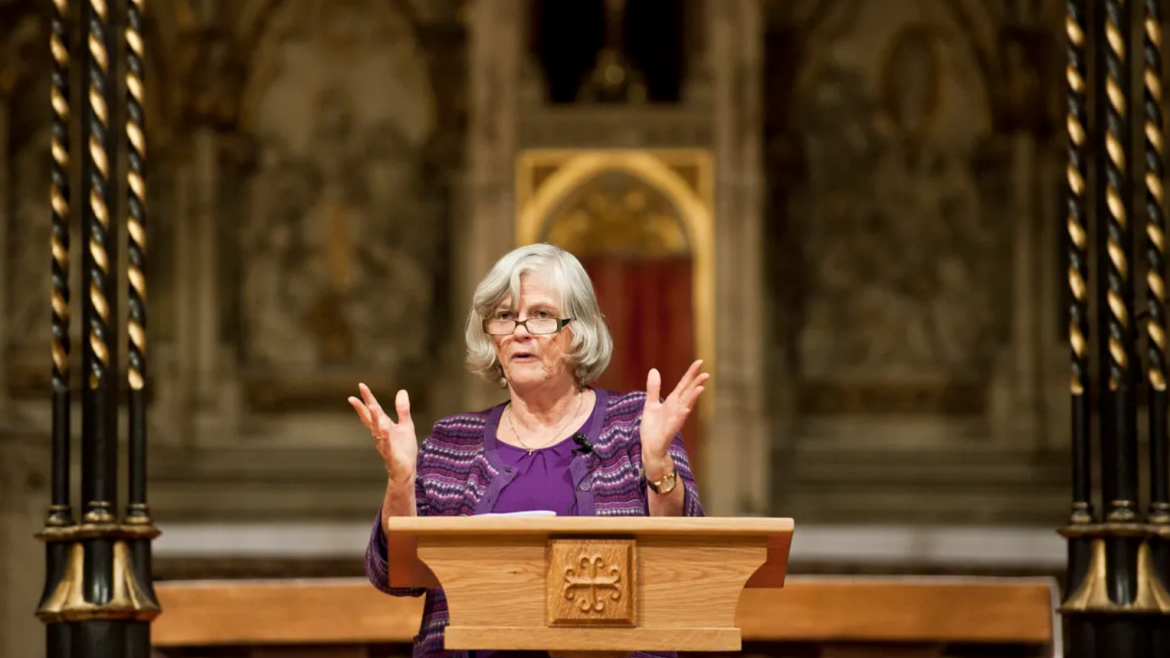 Ann Widdecombe . / Photo via [link]Connected Christianity[/link].
Ann Widdecombe, who died on 9 July, was a remarkable person. Strongly opinionated and possessed of deep conviction yet clearly loved by many who knew her personally. I, like many, have been shocked at the rapidly unfolding story:
Early morning of 10 July, Widdecombe’s management team released a statement confirming her death.
Mid-afternoon of 10 July, police announced a murder investigation and said they were searching for a “white male”. It emerged that Widdecombe’s body was found on the morning of 9 July with “serious injuries”, although police later revealed that she is believed to have died almost 24 hours earlier, around lunchtime on Wednesday 8 July.
Late afternoon of 10 July, police arrested a 26-year-old man in Devon and said there was no evidence of a political motivation for the murder.
Early morning of 11 July, the suspect was released and ruled out from the investigation.
Night of 11 July, police arrested a 28-year-old man in Rotherham, 270 miles from Widdecombe’s home.
12 July, police again repeated that there was no evidence of a political motivation for the murder.
Around lunchtime of 13 July, Counter-terrorism police assumed control of the investigation, saying that new evidence had come to light.
On the afternoon of 14 July, Counter Terrorism police confirmed that the murder appeared to be “clearly targeted” although they were not yet clear to what degree it was planned and what the motivation was.
The investigation into Widdecombe’s murder is ongoing and it would be inappropriate and unhelpful for me to speculate or comment further about that.
All Evangelical Focus news and opinion, on your WhatsApp.
Instead, I want to comment on the way people have spoken about her since her death. Before doing so, a brief summary of her life.
Ann Widdecombe (1947–2026) was a prominent and often controversial figure in British public life. She was Conservative MP for Maidstone and The Weald from 1987 to 2010, holding ministerial posts under John Major.
She later returned to frontline politics as a Brexit Party MEP (2019–2020) and became Reform UK’s immigration and justice spokesperson – a position she held at the time of her death.
She was known for her sharp debating style, her willingness to challenge party leadership, and her uncompromising social conservatism on issues such as abortion, assisted dying, criminal justice, and LGBT legislation.
[destacate]Her life combined political longevity, cultural visibility, and a distinctive moral worldview that made her one of the most recogniable British political personalities of her era[/destacate]She converted from Anglicanism to Roman Catholicism in 1993 over the issue of women priests and frequently framed her political positions in moral and religious terms. She was, it is widely acknowledged, a “conviction politician”.
But there was another side to Widdecombe’s public persona. Beyond politics, she developed a substantial media career that surprised many, appearing in documentaries, quiz shows, panel programmes, and reality television, including Strictly Come Dancing and Celebrity Big Brother, where she became both a polarising and unexpectedly popular figure.
She wrote novels, columns, and an autobiography, and remained a familiar voice in public debate long after leaving Parliament. In retirement she settled on Dartmoor, continuing to write, speak, and engage in public controversies.
Her life combined political longevity, cultural visibility, and a distinctive moral worldview that made her one of the most recognizable British political personalities of her era.
Unsurprisingly, the death of someone who had been so prominent in public life and in some ways controversial drew many responses.
Sadly, some of these lacked the dignity we might hope for in public discourse. LGBT campaigner Peter Tatchell announced on X that, “Tory ex-MP # AnnWiddecombe is dead!”, adding a summary of her record of opposition to LGBT law reforms and closing the comment with, “BIGOT!” [i]
After a backlash at the apparently celebratory tone of his comment, he subsequently apologised for and deleted the post. [ii]
One trans rights campaigner posted on Bluesky, “And some good news for once. I hope it was an extremely painful death”, later adding, “And I hope she was handcuffed to the bed as she screamed in agony.” The person who posted this has defended the posts as an expression of freedom of speech and explained that the reference to handcuffing referred to a story from the 1990s about use of shackles for women prisoners.[iii]
But the campaigner also doubled down on her strong words about Widdecombe, saying, “I’m done being nice to pieces of human garbage like her”.[iv]
It must be clarified that these comments were made before it was revealed that Widdecombe had been murdered and that they are not representative of most LGBT campaigners or political opponents, many of whom expressed shock and sympathy.
There have also been examples of LGBT campaigners speaking with more grace about those who oppose them than some professing Christians have about them.[v]
Nevertheless, that such comments can be made in public is disturbing and reflects a worrying dimension of twenty-first century British culture.
[destacate]There have been comments from numerous people who disagreed fundamentally with Widdecombe on some of her policies, but who have testified to liking her and finding her affable[/destacate]In stark contrast have been comments from people who knew and worked with Ann Widdecombe. Speaking on BBC Radio 4’s PM on 10 July, former Conservative MP Jacob Rees-Mogg spoke of her Roman Catholic faith, which he shares.
He read a prayer by sixteenth century statesman Thomas More – regarded by Roman Catholics as a martyr because he was executed by Henry VIII after opposing his divorce from Catherine of Aragon – and ended saying, “I think Ann lived up to that – up to what Thomas More was asking of people – and I hope, therefore, that she is passing hence into His glory”.[vi]
More remarkable have been comments from numerous people who disagreed fundamentally with Widdecombe on some of her policies, but who have testified to liking her and finding her affable.
Actress Amanda Barrie, who was in Celebrity Big Brother with her in 2018, bore testimony to this on ITV’s Good Morning Britain on 10 July.[vii] She said:
We could not have been more diametrically opposed on gay rights, on politics, on Brexit, on everything. I mean we really were completely different – miles apart – and yet we actually bonded and I found her to be – that big ‘bulldog frontage’ and there was inside a really kind person. And she was really very kind to me […] I absolutely adored her. […] There was a lot of goodness in Ann.
On the evening of 10 July, broadcaster and author Iain Dale, who is openly homosexual and who hosted a theatre show with Widdecombe appeared on BBC Radio 4’s The World Tonight. [viii]
He described Widdecombe as, “one of those people that I always knew that if I was in trouble in any way she would be one of the ten people I would call. And I think that is almost my definition of a true friendship.” When asked how he navigated their different views on LGBT matters, he said, “I would try and soften her at the edges. I knew I was never going to convince her. […] I could send her up and she quite liked that as well.”
To Dale and Barrie, Widdecombe was a trusted friend. I think her reputation for speaking the truth as she understood it was part of the reason why they knew they could trust her. We all need friends like that.
The positive comments from people who knew Widdecombe have often been reported as if they were surprising. It reminded me of the comments I often heard about the late Ian Paisley – known for his strongly held and strongly expressed political Unionism and public morality.
People often said that he was a hardworking and dedicated MP, serving all of his constituents whatever their views and that he was affable in person.
When he and Martin McGuinness were dubbed the ‘Chuckle Brothers’ for their apparent ease of working together in power sharing in 2007, I was not surprised.[ix]
Whilst the arrangement certainly marked a softening of Paisley’s political stance, McGuinness’s testimony after Paisley’s death that he had “lost a friend” was testimony to the personal warmth of the ‘big man’.[x]
Many people in contemporary Western societies seem to struggle to believe that those who disagree deeply can nevertheless be warm, kind, and personally generous.
[destacate]We need to recover the ability to be civil towards one another, and to debate opposing positions honestly. Robust public disagreement must be matched by sincere personal warmth[/destacate]In an age of sound bites and social‑media echo chambers, vitriol is amplified and attempts to understand one’s opponents are drowned out.
Somehow people feel free to speak in ways with a keyboard on a screen that we suspect – or hope – they would not face to face.
We need to recover the ability to be civil towards one another and to debate opposing positions honestly. Robust public disagreement must be matched by sincere personal warmth.
Part of the difficulty is the widespread assumption that views we find distasteful are automatically harmful. That belief shaped some of the initial reactions to Widdecombe’s death from a small number of LGBT advocates.
It arises from a broader cultural outlook — often described as expressive individualism — which holds that each person has an inner truth that must be discovered, expressed, and affirmed for them to flourish. [xi]
When identity is understood primarily in terms of inner psychological experience, disagreement about that experience can feel like an attack on the person themselves.
This outlook may be sincerely held, but it clashes with the Christian worldview that underpinned Widdecombe’s convictions.
If we cannot have an honest debate not only about the views we hold but also about the worldviews that shape them, we can never reach consensus or learn from one another.
That does not mean that hate speech should be tolerated; it should not. But it is important to distinguish hateful speech from principled disagreement.
It is not hateful to argue that desires do not determine identity, or to uphold a traditional Christian understanding of marriage as a covenant between a man and a woman.
These positions can be — and often are — expressed without malice, in a way that honours those who differ, and with genuine goodwill towards them.
Indeed, that ability to honour and bless those who disagree with us is central to the potency of Christian testimony to the truth and grace of God.
This also means that Christians should not speak about others in avoidably offensive ways, using derogatory language or an unloving tone. Our aim must be to speak the truth in love.
[destacate]The ability to honour and bless those who disagree with us is central to the potency of Christian testimony to the truth and grace of God[/destacate]The Christian faith that was central to the lives of Widdecombe and Paisley gave them the resource to do this.
Whilst I was not always comfortable with the way they presented their views – especially the much stronger public rhetoric of Ian Paisley – it seems that both these leaders understood that Christ commanded them to love people even if they disagreed deeply with them.
They were both the kind of conviction politicians that I believe we need, prepared to be honest about their beliefs, to argue their case and to work hard for the good of everyone.
They were both trusted friends even to those who differed profoundly from them because they understood themselves to be accountable to a higher divine authority to speak the truth.
In times when Northern Ireland is reflecting on the exposure of a later leader of the party Paisley founded [xii] and there is great uncertainty about the future political leadership of the UK, we need people like Widdecombe and Paisley. People with whom you may not agree but who you know are being honest and sincere.
The point is not whether the views of Widdecombe or Paisley were right or whether they always used the appropriate tone, but that they were recognisably sincere – and public life suffers immeasurably when sincerity is replaced by performance and self-serving agendas.
Paul Coulter, author, executive director of the Centre for Christianity in Society in Northern Ireland. This article was first published on the author's blog, Connected Christianity. If you would like to be informed when the Christian Leadership Integrity Commitments are released, please subscribe to this blog.
[i]
When left-wing leaders die, the right fall over themselves to honour their best qualities despite political differences (CC: Ruth Bader Ginsburg).
When right-wing leaders are murdered… pic.twitter.com/KBrIjMuzST
— Lois McLatchie Miller (@LoisMcLatch) July 10, 2026
[ii] https://spectator.com/article/the-classless-response-to-ann-widdecombes-murder/
[iv] https://www.yahoo.com/news/us/articles/trans-university-worker-hoped-widdecombe-181859675.html
[v] My colleague Andy Witherall highlighted this to me from this story: https://www.latimes.com/nation/nationnow/la-na-nn-fred-phelps-funeral-20140320-story.html
[vi] https://www.bbc.co.uk/sounds/play/m002ym86
[vii] https://www.itv.com/watch/good-morning-britain/2a3211/2a3211a4381
[viii] https://www.bbc.co.uk/sounds/play/m002ym8q
[ix] http://news.bbc.co.uk/1/hi/northern_ireland/7083818.stm
[x] https://www.bbc.co.uk/news/av/uk-northern-ireland-29176439
[xi] https://foclonline.org/short-talk/sex-and-gender-western-attitudes-towards-sex-and-gender
[xii] https://connectedchristianity.substack.com/p/jeffrey-donaldson-revelations-lessons
[analysis]
[title] Do you see a need for this kind of journalism? [/title]
[text] Evangelical Focus is a network of many people in Europe and beyond who strive to bring a uniquely Christian perspective to the big issues of conversation.
Through news, interviews, opinion and analysis, we seek to build bridges between evangelical churches and the societies in which they live.
As a non-profit entity, the big challenge is to be sustainable, month by month. We invite you to make a difference! Join the readers who make Evangelical Focus possible.
[/text][/analysis]






Las opiniones vertidas por nuestros colaboradores se realizan a nivel personal, pudiendo coincidir o no con la postura de la dirección de Protestante Digital.


Si quieres comentar o