


States do face real threats and evil can sometimes only be checked by force. But the lesson is clear: war is a profoundly blunt instrument for creating justice, reconciliation or lasting order.
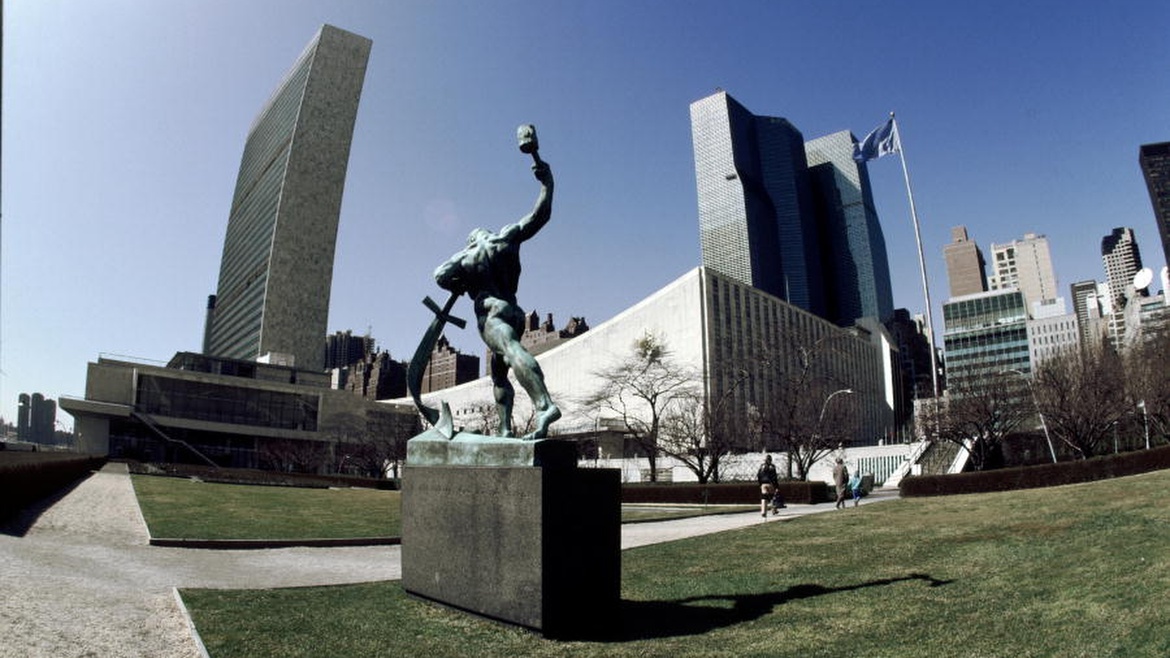 UN bronze statue Let us Beat Swords into Ploughshares. / [link]UN Flickr[/link]
Those who live by the sword, warned Jesus, will die by the sword.
Warmongers, in other words, ultimately wound themselves. The past century illustrates how tragically true that insight has been, culminating in Ukraine, Gaza and Iran today.
During an emergency UN security council meeting last week, the Ukrainian ambassador warned his Russian counterpart that Russia was now experiencing ‘the boomerang of the war launched by Putin against Ukraine.’
All Evangelical Focus news and opinion, on your WhatsApp.
He said the violence Russia had unleashed was ‘returning with triple force and striking with painful precision the very hand that set it in motion.’
Putin’s four-day victory plans over Kyiv have stretched to a four-year-plus disaster, damaging Russia militarily, economically, demographically, diplomatically and psychologically.
They have expanded NATO and bolstered Ukrainian national identity and military prowess.
Those who have initiated wars over the past hundred years may have achieved short-term military gains but not the lasting peace, security or empire they envisioned.
More often, the violence they unleashed returned upon their own societies politically, economically, morally or spiritually.
Adolf Hitler conquered much of Europe in pursuit of a thousand-year Reich. Instead, Germany was devastated, divided and morally disgraced. Millions died in the catastrophe he unleashed.
Joseph Stalin emerged victorious and expanded Soviet power across Eastern Europe. Yet the empire built through force and fear eventually collapsed under its own weight.
Kim Il Sung invaded South Korea hoping to unify the peninsula. After immense bloodshed, Korea remained divided exactly as before.
The Vietnam War, waged mainly under Lyndon Johnson and Richard Nixon, clearly revealed that immense violence failed to achieve the central strategic goal for which it was fought.
Saddam Hussein sought regional dominance through war against Iran and Kuwait. The result was Iraq’s ruin and the destruction of his regime.
George W. Bush’s ‘shock and awe’ launch of the Iraq War aimed to eliminate (non-existent) stockpiles of weapons of mass destruction and reshape the Middle East.
Saddam Hussein fell, but the war destabilised the region, fuelled extremism, and left unhealed wounds.
The same unresolved questions facing Vladimir Putin now surround the wars chosen by Bibi Netanyahu and Donald Trump in Gaza, Lebanon, and Iran.
Their shared contempt for Article 2(4) of the UN Charter gravely threatens world peace: (that) All members shall refrain in their international relations from the threat or use of force against the territorial integrity or political independence of any state.
After the October 7 attacks by Hamas, Israel launched a massive military campaign aimed at destroying Hamas and ensuring such attacks could never happen again.
Yet Hamas has not disappeared. Gaza has endured catastrophic destruction, vast civilian suffering, deep international polarisation and a new generation shaped by trauma and anger.
In Lebanon, Israel has damaged but not eliminated Hezbollah. Instability hangs over both Lebanon and Israel.
In Iran, Trump’s strikes and pressure campaigns sought to cripple Iranian ambitions and weaken its regional influence. They may have delayed Iran’s capabilities, but have also intensified Iranian nationalism and resistance.
Trump’s best deal now is to return things to where they were before he attacked: re-open the Strait, lift the blockade and resume nuclear talks.
Again and again the same paradox is revealed: military force can destroy enemies, but rarely the deeper fears, identities, grievances or ideologies that gave rise to conflict in the first place. Indeed, war often strengthens them.
Nations may win battles and yet lose moral authority. Leaders may achieve tactical victories while sowing the seeds of future instability.
Violence intended to secure peace can instead create cycles of revenge and radicalisation that endure for generations.
Yes, nations have a right to defend themselves. Tyranny must be resisted. States do face real threats and evil can sometimes only be checked by force. But the lesson is clear: war is a profoundly blunt instrument for creating justice, reconciliation or lasting order.
The ancient Athenian historian Thucydides observed that wars begin because of fear, pride and greed, but once unleashed they take on a momentum beyond the control of those who started them.
The biblical prophets echoed similar themes, as they spoke to the very nations where conflict continues today. Isaiah, Micah, Jeremiah and Habakkuk warned that pride blinds nations; fear drives escalation; military power creates illusions of control; violence spreads beyond its original intention; injustice corrodes societies internally; and empires often collapse from the very forces they unleash.
The prophets rarely flattered kings. To rulers tempted by nationalism, militarism, self-glorification or the intoxication of power, they insisted that military success was not the same as righteousness; national greatness was hollow without justice; and the suffering of ordinary people mattered more than the vanity of rulers.
Isaiah urged swords to be beaten into ploughshares. Micah saw a day when ‘nation shall not lift up sword against nation, neither shall they learn war anymore.’
These Hebrew prophets inspired the dynamic sculpture in the photo above that stands as a reminder to the world of the futility of war outside the UN headquarters in New York – a man beating a sword into a ploughshare.
Ironically, it was a gift from the atheistic Soviet Union in 1959. A double irony, in view of the Russian-Ukrainian debate this week in the UN, is that the sculptor – Evgeniy Viktorovich Vuchetich (1908–1974) – was Ukrainian, born in Dnipro.
The prophets still speak profoundly to our own age.
Jeff Fountain, Director of the Schuman Centre for European Studies. This article was first published on the author's blog, Weekly Word.
[analysis]
[title] Do you see a need for this kind of journalism? [/title]
[text] Evangelical Focus is a network of many people in Europe and beyond who strive to bring a uniquely Christian perspective to the big issues of conversation.
Through news, interviews, opinion and analysis, we seek to build bridges between evangelical churches and the societies in which they live.
As a non-profit entity, the big challenge is to be sustainable, month by month. We invite you to make a difference! Join the readers who make Evangelical Focus possible.
[/text][/analysis]






Las opiniones vertidas por nuestros colaboradores se realizan a nivel personal, pudiendo coincidir o no con la postura de la dirección de Protestante Digital.


Si quieres comentar o