


Evangelicals should study the inner dynamics of Rome that allows it to change but not reform itself according to Scripture.
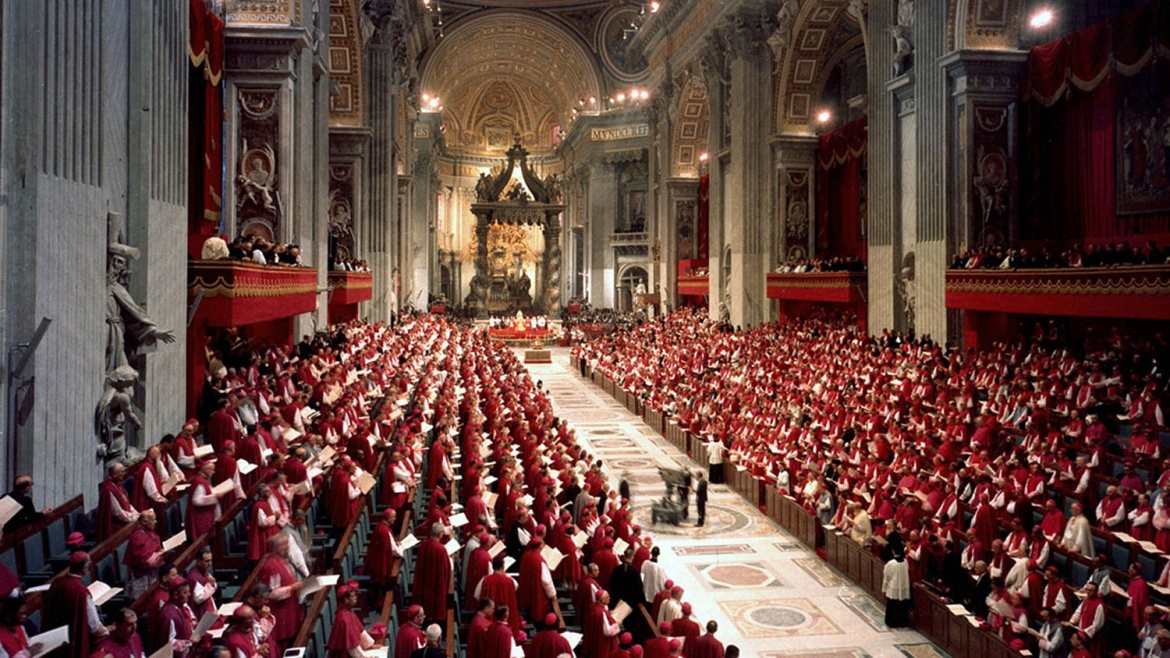 A session of the Vatican II. / [link]Catholic Press Photo[/link], Wikimedia Commons.
Why on earth is a religious event that took place 60 years ago still passionately debated? Most Evangelicals are puzzled when observing the theological and emotional involvement many Roman Catholics show when thinking about the Second Vatican Council (or Vatican II).
Evangelicals may hold the 1974 Lausanne Congress on World Evangelization in high regard,[1] but their investment in discussing the texts and the spirit of the Lausanne Movement is only remotely comparable to the heat generated by the legacy of Vatican II in Roman Catholic circles.
On the one hand, it was no less than Pope John Paul II who bluntly stated that Vatican II is “the great grace bestowed on the Church in the twentieth century: there we find a sure compass by which to take our bearings in the century now beginning.” (Apostolic Letter Novo Millennio Ineunte, 2001, n. 57).
All Evangelical Focus news and opinion, on your WhatsApp.
On the other, there are sectors of the Roman Church that are cold toward the Council, if not critical of its outcomes. The issue of what Vatican II means for Roman Catholicism is still at stake.
Since the beginning of January, Pope Leo XIV has been focusing on the main texts produced at the Council in his Wednesday morning General Audiences given in St. Peter’s Square.
In so doing, he is signaling the permanent relevance of the Council for the Roman Catholic Church and providing his own interpretation of it.
Meanwhile, the theological discussion on Vatican II goes on relentlessly. One of the recent contributions from a group of Italian Roman Catholic theologians is the collection of essays edited by Marco Vergottini, Al cuore del Vaticano II. Una rilettura teologico-fondamentale (At the heart of Vatican II. A theological-fundamental re-reading, Brescia: Queriniana, 2026).
In its four chapters, the book opens some windows on the most important documents, i.e., the four constitutions on divine revelation (Dei Verbum), on liturgy (Sacrosanctum Concilium), on the church (Lumen Gentium), and on the church in the modern world (Gaudium et Spes).
More than touching on the details of each chapter, what is interesting is to appreciate how the whole reception of Vatican II is framed, especially as far as the “heart” of the Council and its significance for the present-day Roman Catholic Church is concerned.
Here is the gist of the reflection echoed in the book. The aftermath of Vatican II has been characterized by an ongoing conflict of interpretations.
After the first phase, when the texts of the Council were commented on in the context of a very positive attitude towards them and in view of the application of its deliberations, later decades have seen the emergence of a critical reading of the Council, sometimes presented as a “rupture” from the established tradition.
Examples of this tendency can be found in the five-volume History of Vatican II edited by G. Alberigo, 1995-2001, and the five-volume Herders theologischer Kommentar zum Zweiten Vatikanischen Konzil edited by P. Hünermann and B.J. Hilberath, 2004-2006.
This reading, which stressed the discontinuity between Vatican II and the pre-Vatican II Church, was opposed by an anti-conciliar sentiment that spread in traditionalist circles.
In their eyes, Vatican II was seen in negative terms and as the cause of all problems. Other interpretations wanted to read Vatican II in merely pastoral terms, as if the Council wanted to update the language of the Roman Church and build bridges with the modern world, but not change its doctrinal posture and traditional practices.
The tension (at times, the chaos) generated by these discussions led Benedict XVI, in his 2005 Address to the Roman Curia, to move beyond polarization by suggesting a mediation in the “hermeneutics of reform” formula.
In pure Roman Catholic style, the two extremes (i.e., discontinuity and continuity) were questioned and replaced with a dynamic category of renewal within the tradition that would account for the developments of the Council while remaining committed to the dogmatic outlook and the self-understanding of the Roman Church inherited from the past.
The book wants to highlight the strategic importance of this dynamic principle both in the drafting of the documents and in their subsequent reception, whereby updating and fidelity are not to be pitted one against the other, but combined in a Roman Catholic, organic way.
Looking at Dei Verbum in particular, here is how it works: Vatican II absorbed some fundamental principles of the two previous Councils (i.e., Trent and Vatican II), yet wanted to overcome their controversial and apologetic thrust (p.60).
In the words of Vatican II itself, “sound tradition” must be retained, and yet “the way remain open to legitimate progress” (Sacrosanctum Concilium, n. 23).
Second, as intuitive as it may sound, the “Traditional vs. Progressive” grid does not fully fit the reality of Roman Catholicism. It probably fitted the “Conservative-Liberal” divide within 20th-century Protestantism, but it does not neatly apply to Rome.
Roman Catholicism has its own way of handling its movements through history. Yes, there are traditional voices, yes, there are progressive tendencies, but the overall direction is not driven by the polarization between the two.
One needs to come to terms with the dynamics of the Roman Catholic system that is Roman (i.e., faithful to its centered structure) and Catholic (i.e., open to ongoing absorptions) at the same time.
Since the biblical Gospel is not the ultimate criterion, the Roman Catholic system is governed by its self-defined Tradition (which swallows the Gospel and does not submit to it) and can oscillate between the Roman and the Catholic poles.
Instead of applying the “Traditional vs. Progressive” opposition in a simplistic way, Evangelicals should study the inner dynamics of Rome that allows it to change but not reform itself according to Scripture.
[1] E.g., The Lausanne Movement: A Range of Perspectives, edited by Lars Dahle, Margunn Serigstad Dahle and Knud Jørgensen (Oxford: Regnum Books International, 2014).
[analysis]
[title] Do you see a need for this kind of journalism? [/title]
[text] Evangelical Focus is a network of many people in Europe and beyond who strive to bring a uniquely Christian perspective to the big issues of conversation.
Through news, interviews, opinion and analysis, we seek to build bridges between evangelical churches and the societies in which they live.
As a non-profit entity, the big challenge is to be sustainable, month by month. We invite you to make a difference! Join the readers who make Evangelical Focus possible.
[/text][/analysis]





Las opiniones vertidas por nuestros colaboradores se realizan a nivel personal, pudiendo coincidir o no con la postura de la dirección de Protestante Digital.


Si quieres comentar o