


Christianity functions as culture rather than discipleship. The faith becomes a symbol of belonging rather than a call to transformation.
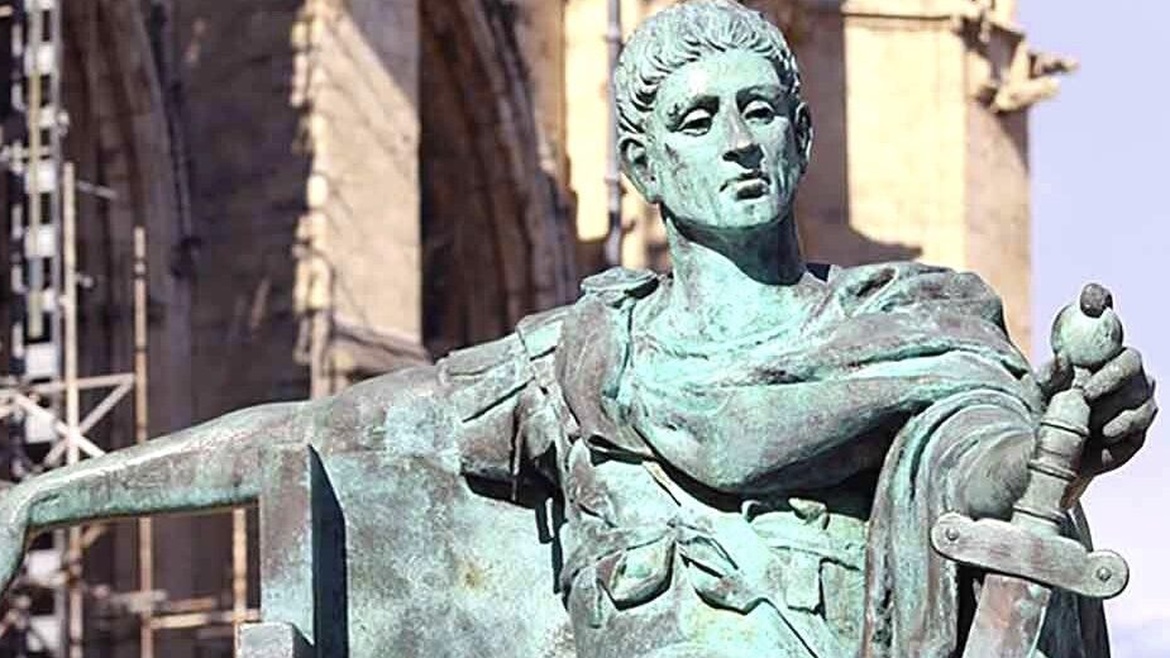 Photo via [link]Weekly Word[/link].
Ever since Constantine in the fourth century, nations and empires have been tempted to define themselves as ‘Christian’.
But can a nation or an empire be ‘Christian’? What happens when it claims to be?
Constantine’s conversion seemed like a wonderful answer to prayer. Persecution stopped. Christianity became the privileged religion of the Roman Empire. Church and state merged. Christianity became fashionable. Massive growth and state funding for churches followed. Nominal Christianity surged.
All Evangelical Focus news and opinion, on your WhatsApp.
But the gospel was compromised. Domesticated. Devalued. The church succumbed to the devil’s temptation of worldly power rejected by Jesus in the wilderness.
It fell for the Constantine trap.
Here we see the first danger of a ‘Christian empire/nation’: Faith is shaped by power, not obedience.
[destacate]The gospel, which spreads through persuasion and witness, becomes associated with coercion. The church gains influence—but loses its integrity and spiritual independence[/destacate] In 800 AD, Charlemagne was crowned Emperor of the ‘Holy Roman Empire’ under a vision of a unified Christian Europe. The goal seemed noble: a civilisation shaped by faith, justice, and order. Yet conversion was sometimes enforced by law.
Thousands of Saxons who resisted were executed or deported. Christianity became intertwined with imperial expansion.
Here we see the second danger: Faith becomes compulsory rather than voluntary.
The gospel, which spreads through persuasion and witness, becomes associated with coercion. The church gains influence—but loses its integrity and spiritual independence.
When Pope Urban II called the First Crusade in 1095, warfare was framed in spiritual terms. Soldiers fought with the cross on their shields, believing their cause was holy.
The result was not only conflict with Muslim powers but also violence against Jews and Eastern Christians. The cross—symbol of sacrificial love—became a banner of conquest.
Here the danger deepened: War itself was given sacred meaning.
The Protestant Reformation challenged the authority of Rome but often retained the Constantinian model. Protestant rulers became heads of national churches.
Faith was tied to territory: to be English was to be Anglican; to be Swedish was to be Lutheran.
The British Empire illustrated this complexity. There Christianity played a significant role in shaping moral vision, education and humanitarian movements, as in William Wilberforce’s battle against slavery.
Yet Christian identity became linked with British power and cultural superiority. (The three states where the monarch, head of state or supreme leader remains the highest religious authority are Britain, the Vatican and Iran.)
The pattern repeats: Christianity becomes civilisational identity, not just personal faith.
[destacate] Christianity functions as culture rather than discipleship. The faith becomes a symbol of belonging rather than a call to transformation[/destacate]This left a mixed legacy, one that combined genuine humanitarian progress with cultural domination. After centuries of religious wars, the cost of fusing faith and state taught Europe that: the church must not control the state, nor the state the church.
This painful lesson helped shape modern Europe’s commitment to religious freedom and pluralism. But today, as new calls arise to defend ‘Christian Europe’ or the ‘Christian West’, the lure of the Constantine trap returns.
In Russia, the alignment between church and state is also explicit. Under Vladimir Putin, supported by Patriarch Kirill, Russia is presented as a defender of Christian civilisation.
War, including the invasion of Ukraine, has been framed in spiritual terms. National destiny is given theological language. When faith and power fuse, the church risks becoming a partner in national ambition rather than a critic of injustice.
Viktor Orbán in Hungary speaks of defending ‘Christian Europe’. He invokes Christianity as cultural heritage, tied to borders and identity. Yet here, Christianity functions as culture rather than discipleship. The faith becomes a symbol of belonging rather than a call to transformation.
The danger is exclusion: Outsiders are seen as threats to Christian identity, rather than neighbours to be loved.
[destacate]Spiritual language strengthens national unity. But even here the temptation must be resisted to sanctify national struggle[/destacate]In the United States Constitution, the founding fathers got the separation of church and state right. But today in Donald Trump’s circles America is again being framed as having a divine mission.
Political struggles take on spiritual language. Opponents are seen not just as wrong but as threats to God’s purposes.
The danger is clear and present: Christianity has become weaponised to ‘make America great’ rather than to offer freedom to all peoples.
Ukraine presents a different case. Facing invasion and destruction, the nation naturally draws on her spiritual legacy for resilience. Churches cooperate in inclusive pluralism to support soldiers and victims.
Spiritual language strengthens national unity under Volodymyr Zelenskyy. But even here the temptation must be resisted to sanctify national struggle. Even a just cause can become absolutised.
Yet Ukraine also offers hope. Many Ukrainian Christians are wrestling openly with how to defend their nation while maintaining gospel integrity.
This struggle may help Ukraine avoid repeating history’s mistakes, when identity replaced discipleship, power reshaped theology, enemies were dehumanised and fear drove faith.
A nation may be shaped by Christian values, justice, truth, dignity, compassion, but it cannot be Christian in the way individuals or communities can. The state wields power.
Following Jesus Christ, the church must be the state’s conscience. Not merely its chaplain.
Jeff Fountain, Director of the Schuman Centre for European Studies. This article was first published on the author's blog, Weekly Word.
[analysis]
[title] Do you see a need for this kind of journalism? [/title]
[text] Evangelical Focus is a network of many people in Europe and beyond who strive to bring a uniquely Christian perspective to the big issues of conversation.
Through news, interviews, opinion and analysis, we seek to build bridges between evangelical churches and the societies in which they live.
As a non-profit entity, the big challenge is to be sustainable, month by month. We invite you to make a difference! Join the readers who make Evangelical Focus possible.
[/text][/analysis]






Las opiniones vertidas por nuestros colaboradores se realizan a nivel personal, pudiendo coincidir o no con la postura de la dirección de Protestante Digital.


Si quieres comentar o