


Most Siberian northern people do not yet have a Bible translation in their own language, nor has a corresponding religious language been developed. Christian concepts can, therefore, only be communicated to a very limited extent.
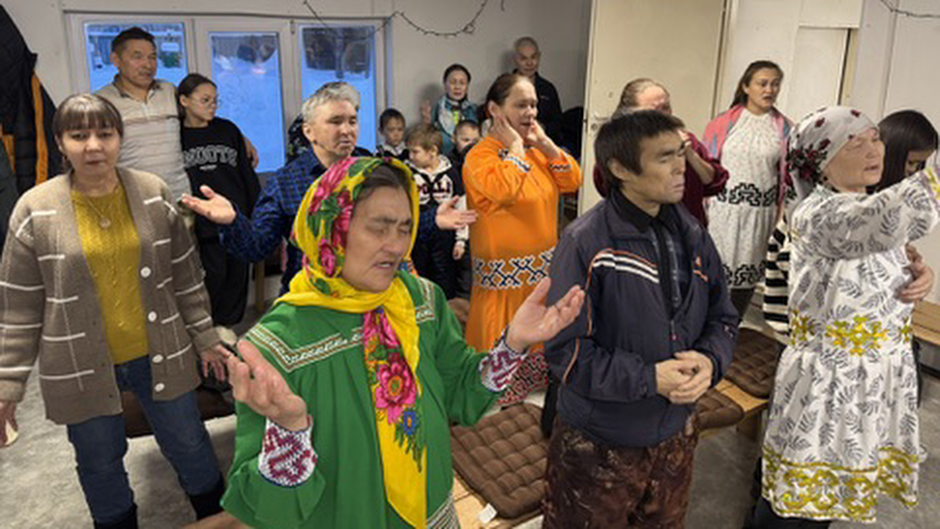 Worship in a Chanty church.
Between 9 and 12 November 2025 I visited Tyumen in Western Siberia. The largest church in the region, “Light for the World,” had invited me to speak at a mission conference. People from many places in Western Siberia came to Tyumen.
Among them were representatives of the indigenous peoples of Siberia. The Finno-Ugric peoples: Komi, Khanty, Mansi, and Selkup live here, numbering several hundred thousand people.
All Evangelical Focus news and opinion, on your WhatsApp.
The originally nomadic reindeer herders are hardly noticed by the population. The vast majority of them have no alphabet and concequently no written language. At the other hand only a minority of them speaks proper Russian. Officially christianized in the centuries of Russian colonial rool. [1]
Most of the Finno-Ugric tribes still practice shamanism. [2]
Protestant efforts to convert the Finno-Ugrians did not begin until the 20th century. An outstanding mission in this regard was undertaken by Russian-German evangelists under the leadership of Johann Peters, who left his home in the Orenburg steppes with his team in the midst of the civil war in 1917 and moved to Western Siberia.
However, the mission was short-lived and only a few Siberians came to believe in Jesus. [3]
It was only after the collapse of the USSR that Protestant missionary organizations began systematic attempts to reach the peoples of northern Siberia with the Gospel.
But their efforts often came to nothing, mainly because they used the Russian language and also Russian piety. Centuries of oppression by the Russian state have created a deep aversion among the local people to anything Russian.
It was only in recent years that Protestant missionaries from Ukraine began to preach the gospel in the languages of the indigenous people.
Now the situation has changed significantly. During my visit to the Chants, the oldest believer in her tribe said, “Jesus has now come to us too.”

[photo_footer]The oldest Chanty believer with bishop Sergei Lavrenov. [/photo_footer]
At the conference held in Tyumen in November, it became clear to all participants that missionaries among the Siberian peoples urgently need better theological training.
Above all, they lack the knowledge and tools for context-appropriate mission. Their own education and development took place in traditional Russian churches.
They are unaware that these forms of faith do not resonate with the indigenous peoples of Russia and particularly in Northern Siberia.
And those among these peoples, who have come to faith in Jesus, rightly ask themselves, how the gospel can be a good news not only for them personally, but also for the community as a whole.
As a result, one hears the most curious questions, such as whether one may pray to God in one's own language, or whether it is better to do so in Russian. Or similar – would it be acceptable to preach in one's muther tongue?
Most Siberian northern people do not yet have a Bible translation in their own language, nor has a corresponding religious language been developed.
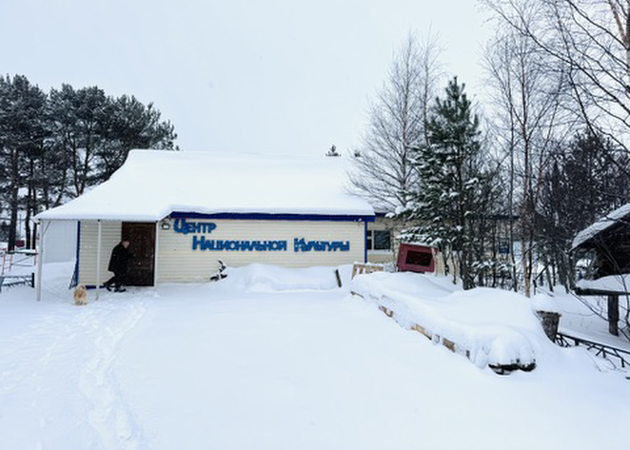
[photo_footer]Chanty church building in the Far North. [/photo_footer]
Christian concepts can, therefore, only be communicated to a very limited extent. Key concepts of faith cannot simply be adopted from a language steeped in shamanism. There is an urgent need for translation work in this area.
This and other reasons lead to an urgent need for a missionary school in Western Siberia.
In great unanimity, the leaders of the West Siberian Evangelical Alliance (WSEA) decided to establish in 2026 their own evangelical university in Tyumen. This school should address the issues of mission in the region.
The leaders hope to receive appropriate assistance from other regions of their own country, as well as from abroad. Such assistance is urgently needed in Siberia, including from us Europeans.
Johannes Reimer, Professor Emeritus of missiology and intercultural theology.
1. See in this regard especially the missionary work of the great Orthodox missionary bishop Stefan Permski (1340-1396) – Johannes Reimer: Mission des altrussischen Mönchtums (Pretoria: UNISA 1994).
2. V. Diószegi, Hrsg.: Glaubenswelt und Folklore der sibirischen Völker (Budapest: Akadémiai Kiadó 1963).
3. See more tot he story: Johannes Reimer: Bis an die Enden Sibiriens: Johann Peters - Vom Leben und Wirken des Ostjaken Missionars (Lage: Logos Verlag 1998).
[analysis]
[title]Join us to make EF sustainable[/title]
[photo][/photo]
[text]At Evangelical Focus, we have a sustainability challenge ahead. We invite you to join those across Europe and beyond who are committed with our mission. Together, we will ensure the continuity of Evangelical Focus and our Spanish partner Protestante Digital in 2025.
Learn all about our #TogetherInThisMission initiative here (English).
[/text][/analysis]






Las opiniones vertidas por nuestros colaboradores se realizan a nivel personal, pudiendo coincidir o no con la postura de la dirección de Protestante Digital.


Si quieres comentar o