


The author’s thinking on the subject is summarized as follows: “God is present in every human being from the moment of conception, not only as Creator, but also as Savior”
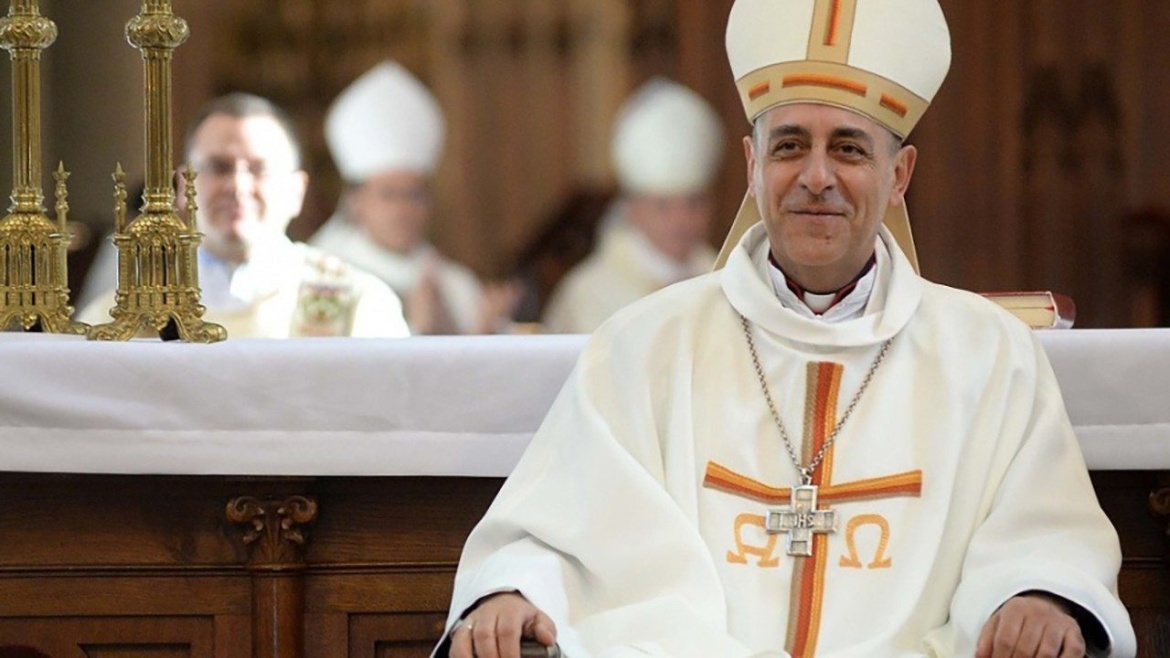 the Cardinal Prefect of the Vatican Dicastery for the Doctrine of the Faith, Victor Manuel Fernández. / [link]Vatican News[/link]
When the Cardinal Prefect of the Vatican Dicastery for the Doctrine of the Faith (Victor Manuel Fernández, number 3 in the Vatican) writes a book, it is worth paying attention.
Cardinal Fernández is also the one who signed “Fiducia supplicans,” allowing the blessing of same-sex unions, and “Mater populi fidelis,” on the use of the Marian title of “co-redemptrix.”
In reality, although the book Grazia. Concetti fondamentali per pensare la vita nuova (Grace. Basic Concepts to Think About the New Life) has only just been published in Italian, it dates back to 2003 and was updated in 2010.
All Evangelical Focus news and opinion, on your WhatsApp.
It was therefore written before he took up his current position as the “guardian” of Roman Catholic doctrine.The theme of grace makes it appealing to the evangelical reader, given the doctrine’s central position in Roman Catholic and Protestant theology.
The author’s intention is not to cover the entire doctrine on grace, but to touch on some fundamental concepts, as the subtitle indicates.
The three main interlocutors considered in the discussion are Scripture, the medieval pair of Thomas Aquinas and Bonaventure, and the German Jesuit theologian Karl Rahner.
The author begins by arguing that grace, biblically speaking, can manifest itself “only in an interpersonal relationship” (14).
In the encounter between people, it is the triune God himself who communicates with our lives (uncreated grace) and brings about effects and consequences (created grace: regeneration, liberation, transformation).
To this understanding of grace, the Roman Church has preferred other contents, making it more of a “thing” to be dispensed, deserved, and administered.
Within the relational conception of grace, the author emphasizes grace as friendship with God, rather than sonship (33).
Here, the sacramental categories typical of Roman Catholicism immediately come into play: at baptism, grace is received in order to be “children of God,” but friendship with God depends on sanctifying grace, which is incremental (38-39).
Within the realm of relationships, even a “non-Christian” can live in a state of grace (44): when one lives in friendship with others, one experiences grace. It is immediately clear that this relational-sacramental understanding of grace lacks the covenantal and juridical categories proper to Scripture.
On the one hand, the sacramental framework of Tridentine Catholicism is reiterated, while on the other hand, the relational emphasis of the contemporary Catholic embracement is affirmed.
This Roman Catholic expansion lacks the covenantal criteria of grace, i.e., we receive grace by the imputation of Christ’s righteousness.
In other words, for the author, God grants us grace by wanting us to be his “friends,” but he fails to say that he does so by not imputing our sins to us, since our Substitute, Jesus, has taken them upon himself.
God is a covenant God, and this covenant is broken because of sin and can only be reconciled through the vicarious work of Christ. Biblically speaking, adoption, sonship, and fellowship with God are grounded in justification.
In his discussion, the author oscillates between harsh judgments against Protestantism and ecumenical attitudes.
Among the former are the accusations of having conceived grace in such a “particularistic” way as to give rise to a “rotten subjectivism” (quoting J.I. Gonzales Faus, 89) and capitalism. Among the latter is the recognition of God’s gratuitous initiative that precedes any moral action on our part (119).
The author’s treatment of Augustine is interesting. The thinking of the “Father of grace” requires “revision” because it has reached “unacceptable extremes” and “exaggerations” that have been harmful (131, 137).
The author seems to understand the reasons of the “semi-Pelagians” who proposed a “middle way” between Augustine and Pelagius (134ff). In fact, even if the Cardinal does not say so explicitly, Roman Catholic theology is closer to semi-Pelagianism than to Augustine.
In line with the Council of Orange, the Council of Trent moves with “caution” and teaches that God inspires us first, but human cooperation is necessary (139).
In explaining how, the author reverses the terms and shows how Roman Catholicism, in calling itself moderately Augustinian, is actually closer to semi-Pelagianism: in fact, God always acts with respect for our fragility (144), in a “resistible” way (151), and starting from human freedom (146, 150), with the exception of Mary, who had “impeccable freedom” (144)!
It is then understandable how convoluted the Roman Catholic doctrine of grace is: in words, it is Augustinian. In fact, it is far from Augustine, with an addition of Mariological exceptionalism.
Within this complex and convoluted vision, baptism is seen as a sacrament that frees us from original sin and disposes us to justification (163). Yet the sacraments are not the only way to grace (162). Traditional sacramentalism is reaffirmed, but open to the universalist demands of contemporary Roman Catholicism.
When it comes to justification, the conceptual difficulty that pervades the book emerges even more clearly. Without any biblical support, justification is understood as “the very fact of being a friend of God” (178).
Instead of accepting the legal categories of Scripture, friendly categories are preferred, which are not proper to justification. In addition, two modes of God’s action (transforming and impelling) are associated with justification.
First, it is said that grace precedes works, but then it is also argued, with Thomas, that one can dispose oneself to justification by giving consent (197).
This cooperation is of “variable intensity” (198) or “different intensity” (200). In short, without the forensic framework of Scripture, justification is sometimes thought of as friendship, sometimes as a gift, and sometimes as something to be prepared for through one’s own cooperation.
The final theses proposed by the author are a theological potpourri (243-245).
In a nutshell, Roman Catholic justification brings together all the complexity of the layered tradition of Catholicism: a little of Augustine but without the gravity of sin, a little of semi-Pelagianism that emphasizes our ability to collaborate, the subtle distinctions of Thomas Aquinas, the sacramentalism of Trent, the catholicity of Vatican II whereby even non-Christians can be justified (223).
One of the last chapters deals with the Roman Catholic-Lutheran dialogue on justification.
The interpretation offered by the author is in line with the mainstream ecumenical view: the two views (Catholic and Lutheran) are “two aspects of the same truth” (208) that use “different expressions” (209) to refer to the same reality interpreted in the light of different concerns.
In light of the 1999 Joint Declaration, anathemas have become “salutary warnings” that no longer apply (211). As for other religions, given the absence of forensic categories, justification can be accessible in various degrees of fullness (224-225): only the Roman Catholic sacraments guarantee the greatest fullness.
In the end, the author’s thinking on the subject is summarized as follows: “God is present in every human being from the moment of conception, not only as Creator, but also as Savior” (235). This is the catholicity of grace in contemporary Roman Catholicism. Without the legal/covenantal understanding, one slips into the universalism of salvation.
The book introduces us to the universe of contemporary Roman Catholic theology of grace, in which everything can be found except a firm commitment to respect the biblical teaching that “by grace you have been saved through faith, and this is not from yourselves; it is the gift of God” (Ephesians 2:8).
Leonardo De Chirico, theologian and evangelical pastor in Rome.






Las opiniones vertidas por nuestros colaboradores se realizan a nivel personal, pudiendo coincidir o no con la postura de la dirección de Protestante Digital.


Si quieres comentar o