


We talk on the situation in Venezuela with Mishelle Mitchell and Joao Diniz of World Vision. Over two months after the earthquakes “churches have been, and still are, essential”.
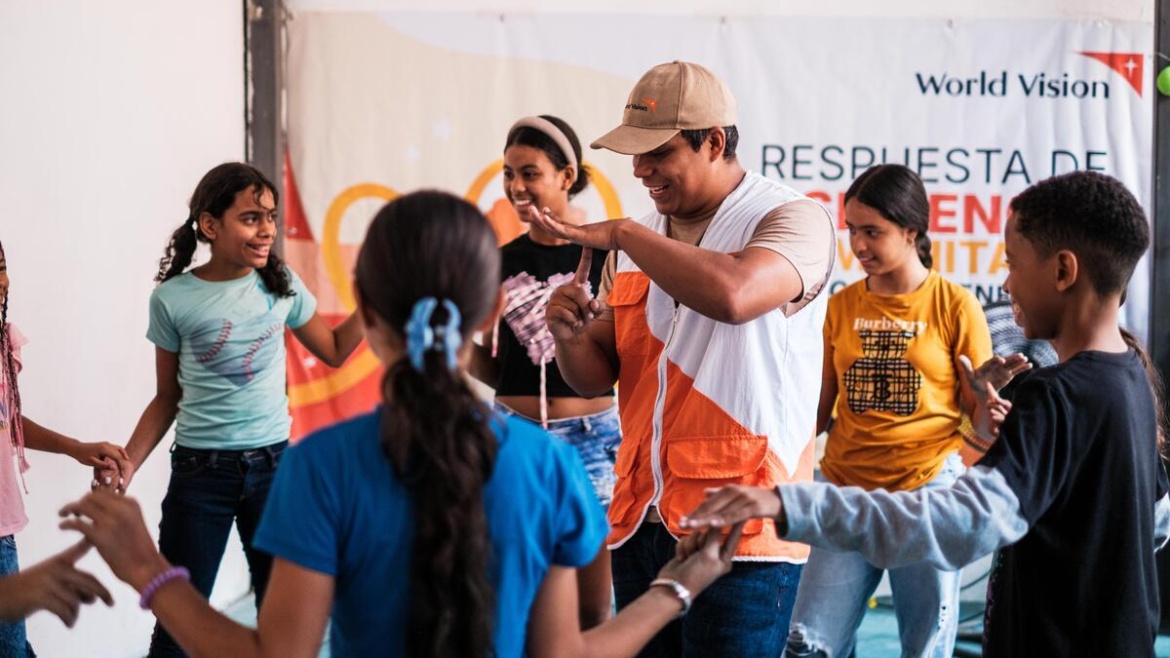 ‘Child-friendly spaces’ are a World Vision project that aims to provide psychosocial support to children who have been affected by the earthquakes in Venezuela. / World Vision.
Two and a half months after two earthquakes measuring 7.2 and 7.5 on the Richter scale struck the central coast of Venezuela, the official death toll stands at over 6,500, with thousands more displaced and missing.
There is still much to be done to rebuild what was destroyed, and above all to support those who lost everything.
Christian organisations including World Vision continue to provide aid, particularly to children, who are the most vulnerable.
All Evangelical Focus news and opinion, on your WhatsApp
Spanish news website, Protestante Digital, talked to Mishelle Mitchell, World Vision's Regional Director of Advocacy, External Engagement and Communications for Latin America and the Caribbean, who has just returned from Venezuela, and to João Diniz, Regional Director of World Vision in Latin America and the Caribbean, about the current situation in the country and the work the organisation is doing there.

[photo_footer]World Vision has set up a shelter on a former golf course in Venezuela. / WV [/photo_footer]
Question. How does an organisation like World Vision work to respond in the face of tragedies such as the one in Venezuela?
Answer. Firstly, it is important to understand that World Vision is a Christian organisation and our mission is to protect the dignity and lives of children in different contexts. Therefore, we always work through local communities.
We have been present in Venezuela since 2019, providing support during the migration crisis, and we already have a network called 'Esperanzas en Fronteras' (Hopes at the Borders), which includes over 2,000 Christian leaders from several churches.
That is why, when the earthquake struck, which, for us, is a tragedy within a tragedy, the churches, despite being affected, were the first to respond.
We started with an “information tree”: when the earthquake hit, almost everyone was watching the football World Cup and our first priority was to make sure everyone was safe. Then came the assessment process of identifying needs and priorities, which was carried out at an impressive speed.
Some of our colleagues, such as the communications manager and the programme director, had to evacuate their buildings because they had become uninhabitable while, at the same time, they were coordinating what needed to be done.
Within hours of the earthquake, we had already dispatched 30 motorbikes carrying 30 doctors to provide primary care in areas that were inaccessible, but World Vision was already on the ground and able to help.
This is not a speed race; it is a marathon; what took decades to build will now take decades to rebuild.

[photo_footer]Mishelle Mitchell in one of the ‘child-friendly spaces’ set up by World Vision Venezuela./ WV [/photo_footer]
Q. What needs and challenges have you identified in the worst-affected areas?
A. We are at a stage where basic needs have not yet been met. People are living in tents and relying on communal kitchens and hygiene kits that we are providing. There is still no drinking water.
Amidst all this, the risk of child exploitation and trafficking is increasing, which is why World Vision also needs to start thinking about reconstruction and the future, so that those families have a place to live.
To this end, we are focusing on their livelihoods, and on how we can support them to move forward through economic activity that will enable them to become independent.
Another priority is the children who have been rescued from the rubble and are now alone. In Venezuela, more than a million children had already lost their parents when they migrated, and now they have lost the uncle, older brother or neighbour who was caring for them.
Water and sanitation are also very important. Currently, they have no water for drinking or cooking, and proper sanitation would protect them from disease.
Furthermore, 80% of the area relies on tourism for its livelihood, yet over 80% of the restaurants, hotels and casinos have disappeared. How are these people going to make a living? How can an economy be revived?
The new school year is due to start on 19 September. Which school will they return to? Because the schools have probably disappeared and many of the teachers may no longer be there.

[photo_footer]Joao Diniz in a World Vision project / WV. [/photo_footer]
Q. How important is the collaboration of churches and Christian organisations in this crisis?
A. As the body of Christ, the church bears witness of hope, love and service to others. As a Christian organisation, we must be clear about our calling to follow Jesus Christ wherever he is. That is where we go, because he is already there.
In that sense, the work of the churches has been and still is essential for us.
We could give hundreds of examples. For instance, Pastors Alexis and María Paz, from a church in La Guaira, lost their son, their grandson and 40% of their congregation, but were still the first to open their church and help those who had lost everything. The Vino Nuevo church was also affected, but was one of the first to respond.
Furthermore, the United Nations has recognised our approach of relying on the local church. The World Food Programme needed to carry out a general assessment of the food security situation in Venezuela, but was unable to reach many areas for obvious reasons, so they approached us and we carried out the assessment through the local churches.
However, even though our communities always have their doors open, not all of them have the skills and resources to provide assistance in emergencies like this, so our role is also to equip the church so that it can be more effective.
As a Christian organisation, another part of our work is to look after the carers within the churches. Many of the activities we carry out are with the pastors who oversee these carers. The Brazilian Baptist Convention and the Brazilian Evangelical Alliance have joined this project to support us.

[photo_footer]World Vision staff at the shelter they have set up on a former golf course in Venezuela / WV. [/photo_footer]
Q. Mental health is one of the major challenges in emergencies such as the earthquake in Venezuela. How do you deal with this?
A. Psychosocial support is essential for child protection. That is why, in both Venezuela and Colombia, one of the first things we implemented was what we call “child-friendly spaces”.
These are mobile spaces that provide psycho-emotional support, designed to make children feel safe while helping them, through play and other activities, to cope with any trauma they may experience from losing their entire environment.
In Venezuela, we have four of those spaces which move from place to place so that we can reach different communities. Over the past two and a half months, more than 27,000 children have participated in that iniciative.
All of this work is based on an approach we call 'Tenderness', which we have been working with for 13 years in Latin America. It aims to provide tools and processes to heal wounds and create safe environments. We recently held a conference on this approach, attended by 500 people.
You can feed a child and give them something to drink, but we would not be doing our job properly if we failed to protect their heart and mind.If trauma is not addressed, it often manifests in adulthood as an increased risk of chronic illnesses, heart disease, and the likelihood of suicidal thoughts.
This approach enables us to identify patterns of violence or relational issues in both children and adults that have been passed down through generations, thereby ensuring comprehensive protection.
We seek to protect children from risks such as exposure to drug use, potential situations of abuse, child labour, exploitation of forced begging because they are no longer in school and there is no income. Managing this also means safeguarding their mental health.
We keep rigorous records of who comes in, who leaves and who has custody of each child. When cases put a child at serious risk, they are referred directly to the authorities.
Ultimately, our goal with these programmes is for children to experience God’s love.

[photo_footer]Mishelle Mitchell with Venezuelan children affected by the earthquake in one of the ‘child-friendly spaces’ ./ WV [/photo_footer]
Q. How can Christians support the work that World Vision is doing in Venezuela?
A. Above all, through much prayer, because we must not lose heart for the people of Venezuela or those in Colombia who are experiencing a similar situation. Now is the time to sustain them in prayer.
Then, the first point of contact to donate is World Vision Spain and World Vision Latin America. There is an immense need for resources.
We are asking for cash donations because importing goods is still logistically complex, and even if people donate items, it is difficult to send them and they take a long time to arrive.
We are using the donations to source supplies locally, which also helps to revive local economies.
We are always transparent, and our social media channels are open so people can see what we are doing.
We have already reached almost 92,000 people, 27,000 of whom are children, in the first two months alone. We hope to reach more people, and, as we have said before, churches are particularly important in providing this care and support.
[analysis]
[title] Do you see a need for this kind of journalism? [/title]
[text] Evangelical Focus is a network of many people in Europe and beyond who strive to bring a uniquely Christian perspective to the big issues of conversation.
Through news, interviews, opinion and analysis, we seek to build bridges between evangelical churches and the societies in which they live.
As a non-profit entity, the big challenge is to be sustainable, month by month. We invite you to make a difference! Join the readers who make Evangelical Focus possible.
[/text][/analysis]




Las opiniones vertidas por nuestros colaboradores se realizan a nivel personal, pudiendo coincidir o no con la postura de la dirección de Protestante Digital.


Si quieres comentar o