


In a Canary island, pastor Toni Quesada promotes a project that aims to prevent reoffending through social and spiritual support.
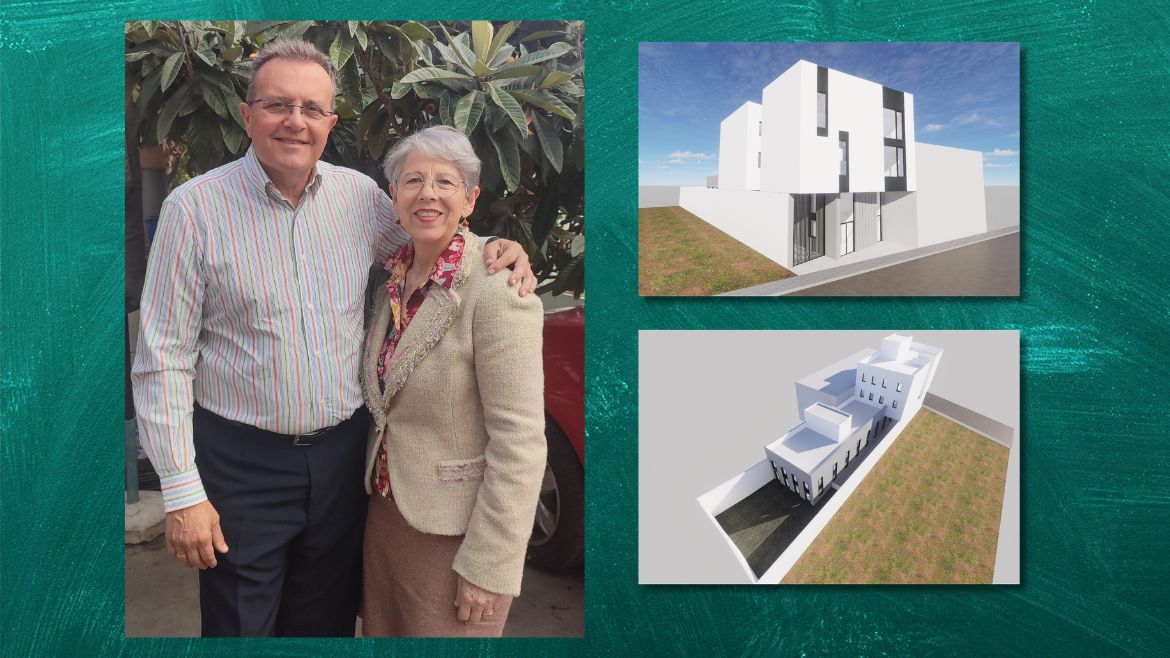 Toni Quesada and his wife Pili, with sketches of the project they are promoting. / PD
Entrepreneurship is about starting and developing a new project, taking financial and personal risks with the aim of solving a need. Therefore, it is not an exclusively business-related concept.
For pastor Ángel Antonio Quesada, better known as 'Toni', that need exists within prisons, a conclusion he reached after dedicating 26 years of his life to prison ministry in the Spanish island of Gran Canaria.
At 64, he continues to promote new alternatives for social reintegration and a deeper understanding of the true meaning of forgiveness.
All Evangelical Focus news and opinion, on your WhatsApp.
Spanish news website, Protestante Digital, talked to pastor Toni Quesada about his ministry.
Question. How did you get involved in prison ministry?
Answer. My wife Pili and I became full-time pastors in 1996. A year later, an Irish missionary invited me to serve in prisons. He had to return to his homeland and didn't want to leave the prisons without assistance. He prepared me to carry out this work.
Q. What motivated you to continue for so many years?
A. The need those places have for Jesus' love and forgiveness. People inside the walls need to vent, and I'm good at listening. I speak when I have to speak, but in that situation, they long to express themselves more than to listen.
I simply sat down to interact with people. I shared about God's love and how He sees us all as equals. I spoke and continue to speak to them about forgiveness.
Q. How do you explain the concept of forgiveness in a culture that exalts revenge?
A. People can offend each other and then ask for forgiveness, but we must understand that things work differently with God. When we sin, God is the first person offended because we are attacking His work.
We explain that forgiveness means acknowledging that our sins have been placed on Jesus' shoulders, and that is the greatest gift ever given to humanity.
I recently saw a forensic psychiatrist on national television who questioned the Christian concept of forgiveness. It was clear that he did not understand the concept of grace.
You cannot understand God's work unless you allow Him to work in you. Human 'sanity' cannot comprehend the extent of God's love.
Q. Have you ever found it difficult to forgive someone?
A. As a human being, yes, both forgiving others and asking for forgiveness. Today, I thank God for His mercy, and for the support and comfort of my brothers and sisters in my most difficult moments.
For God, forgiveness comes naturally, but for human beings, it requires effort and is something we must always practise.
The world does not understand that people are capable of recognising their wickedness and understanding their need to repent and be forgiven. That is why many judge and say, 'Do you really believe this person is repentant?' I don't know; only God knows.
For those who do not give themselves the opportunity to learn about grace, the concept of forgiveness falls short.
Q. How do those who hear the message of salvation in prison change?
A. Right now, for example, we are trying to help someone who killed his father with an axe. People believe that change is immediate, but it is generally a long-term process.
I remember the case of a young man who was arrested at 16 for stabbing someone. After reaching adult age, he was transferred to an adult prison, but he kept getting out, reoffending and returning.
This man spent almost 40 years of his life in prison. Once, we were talking near a corridor where the rapists were kept, an isolated area because that type of crime was severely judged by the inmates' codes.
Then he said to me, “See one of those? If you tell me to kill him, I'll kill him”. I explained that I am not the one to decide who lives or dies. I also told him that, like everyone else, this man has to answer to God and needs His forgiveness.
I don't know if he fully understood this at the time, but his behaviour changed little by little. These processes take time, even after prisoners have served their sentences.
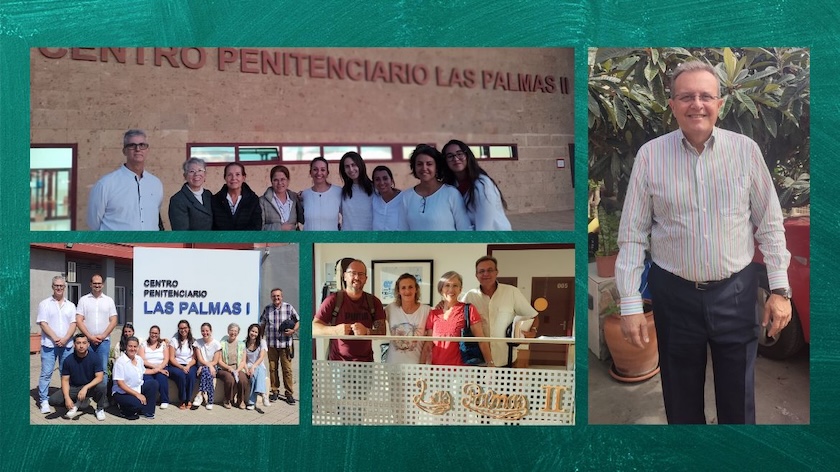
[photo_footer]Teams visiting prisons. [/photo_footer]
In addition to being a prison chaplain and president of the Evangelical Council of the Canary Islands, Toni is a pastor at an evangelical church located ten minutes from Las Palmas II prison in the Canary Islands.
Throughout his ministry, he has accompanied thousands of inmates. He is currently promoting the creation of a space that will house the church and serve as a reception centre for people in post-prison situations, with the aim of preventing reoffending through social and spiritual support.
Q. How did this shelter project begin?
A. Right now, there is a need for a space where the church can be located, as well as one that can accommodate prisoners on leave and those who lack adequate family support.
We have had to take people from Spain, Indonesia, Sweden, the Dominican Republic, Ghana and Nigeria into our own homes, but they are not ideal places for them.
Q. What are the characteristics of this new space?
A. The aim is for it to be used as an overnight accommodation centre. People will be able to have dinner, shower, change their clothes, sleep and have breakfast in the morning before leaving to start sorting out their paperwork and looking for work.
They would arrive and leave at set times. There would be two floors, with women and men housed separately. The building would have the capacity to accommodate six people, plus the person in charge.
As a church, we will have the opportunity to provide spiritual support through meaningful conversations and sharing the Word of God.
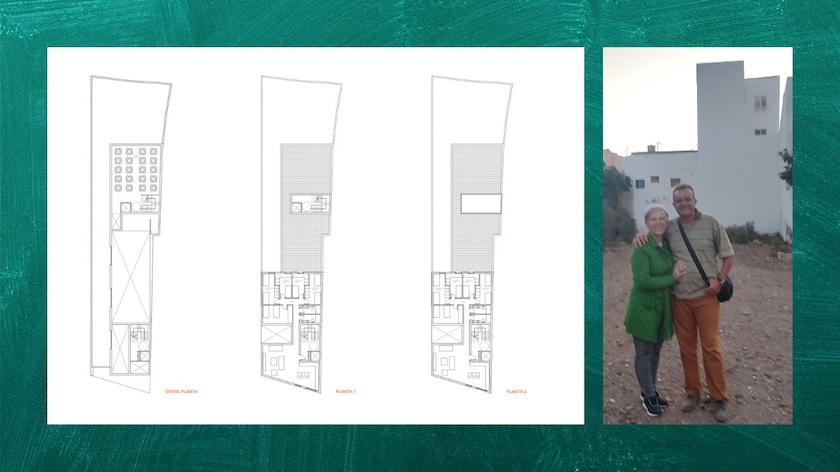
[photo_footer]The project plans on the land where they want to carry it out. [/photo_footer]
Q. When will construction begin?
A. We submitted the documentation to the City Council, paid for the licence and are now waiting for a response. The estimated start date also depends on our financial resources.
Thanks to God, we have received responses from some Spanish churches and other brothers and sisters from outside the country. However, we still need to complete the budget. Nevertheless, we trust that the Lord will provide the necessary resources.
Q. How important is this project for the island?
A. We will be the only place on the island of Gran Canaria with the capacity to welcome these people. We are breaking new ground as pioneers. I don't know if I will live to see it, but I hope so.
The prison ministry led by Toni and his wife Pili is made up of five other people. They divide into two groups to serve the prisons on the island.
These believers visit the prisons twice a week to bring the good news of salvation.
This article was produced for the Líderes Empresariales section of Protestante Digital, an initiative of the Gospel, Economy and Business (Tres-E) group in Spain.
[analysis]
[title] Do you see a need for this kind of journalism? [/title]
[text] Evangelical Focus is a network of many people in Europe and beyond who strive to bring a uniquely Christian perspective to the big issues of conversation.
Through news, interviews, opinion and analysis, we seek to build bridges between evangelical churches and the societies in which they live.
As a non-profit entity, the big challenge is to be sustainable, month by month. We invite you to make a difference! Join the readers who make Evangelical Focus possible.
[/text][/analysis]





Las opiniones vertidas por nuestros colaboradores se realizan a nivel personal, pudiendo coincidir o no con la postura de la dirección de Protestante Digital.


Si quieres comentar o