


.jpg)
What explains the fact that two out of every three practising Christians in the UK now identify as evangelical? Danny Webster, one of the authors of the report ‘Understanding UK Evangelicals’, answers our questions.
.jpg)
Evangelicalism cannot be ignored. If you meet three people who practice their Christian faith, go to church, read the Bible and pray, then two of them are likely to be evangelicals.
.jpg)
A major survey shows that there are 5.5 million committed evangelicals, 8 per cent of the population. Around 40 per cent of them are under the age 35, the Evangelical Alliance United Kingdom reports.
.jpg)
A survey shows that those aged 70 and over are the most sceptical: only 20 per cent agree with this biblical doctrine.
.jpg)
Penzberg is the first to list the mosque alongside the Catholic and Protestant churches. The town’s religious leaders are in agreement, but a survey shows that the majority of Germans reject it.
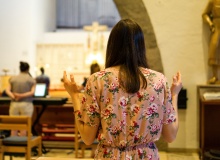
Government statistics from 2026 show that 40% of people identify as “nones”. Although church weddings continue to decline, more young people say they believe in God.
.jpg)
85% of evangelicals agree that Christianity has helped shape UK’s democracy. A study by the Evangelical Alliance also examines voting intentions.

For the first time since 1998, the proportion of people who do not attend religious services outnumbers those who attend occasionally.
.jpg)
According to a survey, 28% say they believe in the resurrection, 9% up compared to 2022. Younger adults are the most likely to hold this view.
.jpg)
Generally speaking, one in three Germans believes in this Christian doctrine. But there are notable differences.
.jpg)
What 10 European countries think about gambling, marital infidelity, homosexuality and abortion, according to a major survey by Pew Research.
.jpg)
Twenty-six per cent of respondents in five countries surveyed agree with the following statement: “If my country had a capable and effective leader, I would not mind if they limited democratic rights and were not accountable to citizens for their actions”.

The number of mainline Protestants and Roman Catholics has fallen to 19% and 30%, while free evangelicals remain stable at 6%.
A report of the EAUK analyses what prompted those with no Christian background at all to search for God, what helped them along the way and what’s happened since.
.jpg)
The study corroborates the advance of secularism, while minority religions and spirituality not regulated by religious institutions are emerging. New references to purpose in the family, pets or nature are on the rise.

Experts on spirituality and youth in Spain stress the need for a more concise analysis to understand current Generation Z trends.
.png)
Radical politics, AI and the debate on human identity are the issues for which churches are least prepared, finds the new Global Voices survey conducted by the Lausanne Movement worldwide.
.jpg)
Young people and those who are members of free evangelical churches are the most likely to believe that God created the universe.

A Pew Research Center survey shows that ‘nones’ in Europe “are much less inclined” to believe in God, and “tend to voice negative views of religion”.

The federation of French mission organizations launches a national questionarie to “gain a broad overview of what evangelicals in France think about missions”.

I consider Christian nationalism a form of idolatry, because it elevates one’s nation to a position that should be reserved for God.

The decline of Catholicism in the country of Pope Leo XIV is linked to a loss of confidence in the institution, finds the Institute of Peruvian Studies.

Young people aged 18 to 29 are most likely to believe that only men and women exist (69%). Members of free churches and Muslims are most likely to agree.
.jpg)
The increase in young men is fivefold, and 37% of all those under 24 say they are curious about the Bible. The YouGov study points to a steady decline in nominal Christianity but faith is becoming “even culturally attractive”.
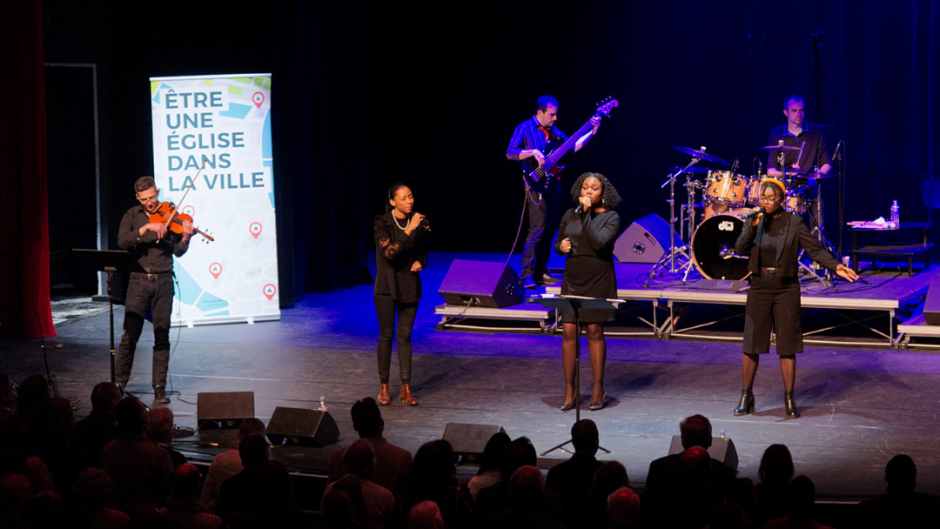
According to IFOP, 24% of Protestants in France are converts from another background. Young people attend church more, and those from lower socioeconomic classes identify more as ‘evangelicals’.





Las opiniones vertidas por nuestros colaboradores se realizan a nivel personal, pudiendo coincidir o no con la postura de la dirección de Protestante Digital.

