


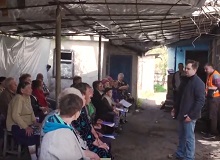
As the war in Ukraine continues, local pastors on the frontlines are putting their faith into action. Vyacheslav Balagura (Donetsk Regional Church of God Pastor) and Peter Dudnyk (Church of God Missionary Coordinator for Ukraine union) share about their work. OM teams work with several churches in the cities of Odessa, Rivne, Vinnitsa, and Kaharlyk.
A Pew Research Center survey shows that “people in emerging economies tend to be more religious and to say that belief in God is necessary to be moral”.
The Luhansk People's Republic (Ukraine) has banned all Protestant worship, and believers try to meet in small gatherings. Uzbekistan raids worship services that have not been approved by the authorities.
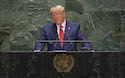
The US President presents a plan that includes the creation of “a coalition of businesses for the protection of religious freedom”.
Irina Volodrska (Jews For Jesus, Ukraine) and Elia Daoud (Evangelical Alliance of Arabic Speakers in Europe) speak about how they share the gospel with their own people.

Zelenskiy beat incumbent President Petro Poroshenko with 73% of the votes.“There is still a chance for Ukraine to improve its relations with Russia”, Russian Prime Minister, Dimity Medvedev said.
Many are coming to Christ in some of the toughest prisons in this troubled part of the country.
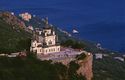
Most administrative prosecutions end in punishment. Many are prosecuted for sharing their faith on the street. “Believers go out to share their faith less often, and give out publications or invitations less openly”.
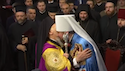
Under the decree of autocephaly, the new church’s jurisdiction will be restricted to Ukraine. The Russian Orthodox Church reacts: “It is the result of political and personal ambitions”.
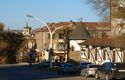
There have been repeated raids on churches by the Luhansk People's Republic. Authorities announced the ban of the “destructive activity of the extremist Ukrainian Union of Evangelical Churches”.
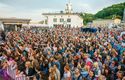
The festivals are centered around one goal - to build up this country where family and Christian values are the focal point of the public traditions and of the state policies.
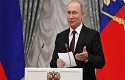
The president got 75% of the votes, his biggest electoral victory. The future of religious freedom for the evangelical minorities is very much dependent on the course of East-West relations.

Public gatherings, concerts, television broadcasts and creative initiatives in many countries.
We should pause to ask what causal links can be demonstrated between the Reformation and economic growth, democratic stability, and social justice in Protestant-background countries.
A recent EBF Mission Partnership conference in Georgia sought to ‘encourage, and inspire in ministry’ a group of indigenous church planters from Eastern Europe.
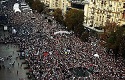
About 160,000 Christians gathered in Kiev. Evangelicals are “grateful for the opportunity and freedom to share the Good News in Ukraine today”.

Slavik Lytvynenko is an Ukranian research professor in Prague. “Athanasius taught me that work has meaning only when done with the divine perspective in mind”.

Around 130 delegates from different parts of the country reflected on the role of Christians. A manual for counselling the victims of violence has been published.

A selection of pictures of World Press Photo 2017.
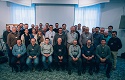
Representatives of 11 countries met in the Czech Republic to discuss the present and future of theological education in Central and Eastern Europe.

One in three citizens think corruption is one of the biggest problems facing their country. Ukraine, Moldova, Bosnia and Herzegovina and Spain are the worst judged.
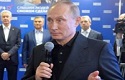
Election in Crimea is questioned by many states. Only 47% of population voted. Evangelical Christians suffer under anti-evangelism law.
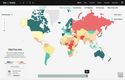
Institute for Economics and Peace says global deterioration “was driven by increased terrorism and higher levels of political instability.” Europe is the most peaceful region in the world, but Ukraine is the second country whith a bigger deterioration.

Freedom needs spiritual values, internalised discipline and self-government. The truth will set us free, Jesus promised.
France, Ukraine and Russia are the top three countries of origin. Terrorist attacks and anti-semitism in Europe could be main reasons of increase, say experts.





Las opiniones vertidas por nuestros colaboradores se realizan a nivel personal, pudiendo coincidir o no con la postura de la dirección de Protestante Digital.

