


Amid a complex political situation, the EAD issues a position paper to “support evangelicals in addressing political and social issues responsibly from a Christian perspective”.
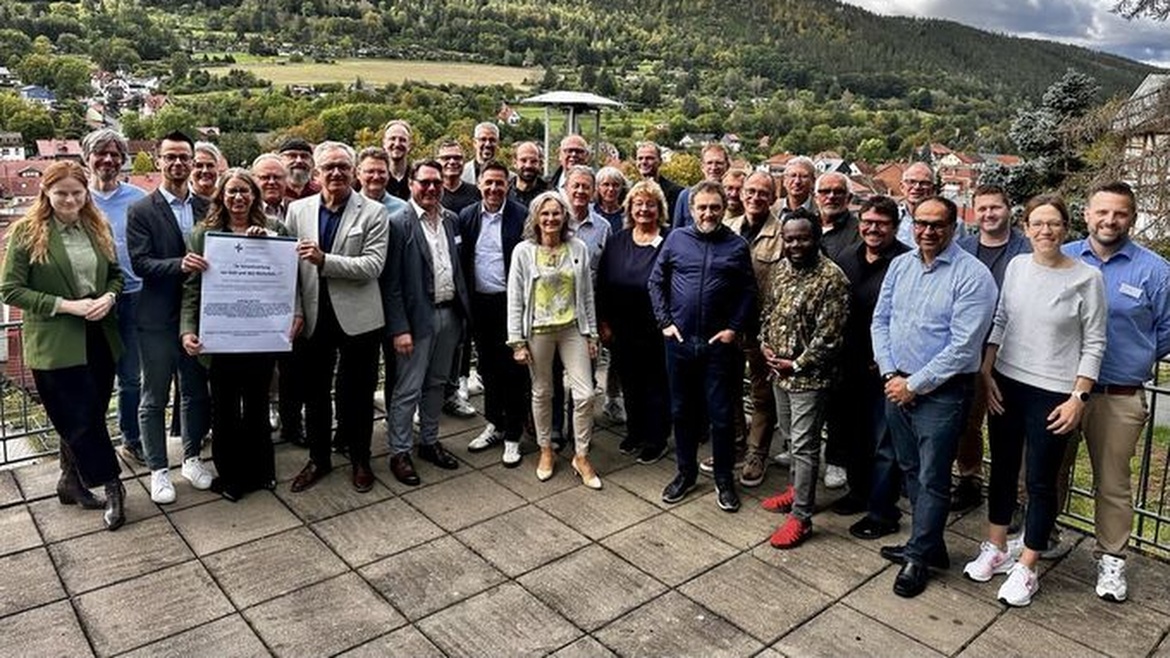 Participants a the EAD convention. / [link]EAD[/link]
During its meeting in the German city of Bad Blankenburg, the Convention of the Evangelical Alliance in Germany (EAD) adopted a position paper on the relationship between politics, the Christian faith and social responsibility.
The paper, called ‘Accountable to God and to People – Politics, the Christian Faith and the Evangelical Alliance’, aims to “support congregations, local alliances, organisations and committees of the Evangelical Alliance in addressing political and social issues responsibly from a Christian faith perspective”.
All Evangelical Focus news and opinion, on your WhatsApp
It is divided in three parts: a biblical-theological framework, a shared fundamental public position and a toolkit for social dialogue.
“Christ is our unifying foundation; the Word of God our guiding principle; the God-given dignity of every human being non-negotiable; love our path, and hope our horizon”, states de EAD at the beginning of the document.
According to the Convention, “Jesus did not proclaim a political programme, yet his message is not apolitical: it relativises any absolute claim to power and subordinates it to service and obedience to God”.
That is why “no party, ideology or nation may claim the ultimate loyalty that Christians owe to God alone. The strength of our cohesion lies in our unity founded on Christ and not in shared political positions”, they add.
The paper points out that “Christians respect the law, pray for those in authority and play an active part in shaping society”. That includes “justified and clear criticism”, which “does not question the legitimacy of state authorities, but rather draws attention to failings”.
“Christian hope does not depend on political developments living up to our expectations. It counts on and prays for God’s intervention; offers us a vision of the future that is not threatened by fear, cynicism or resignation; and empowers us to act responsibly, even when political solutions remain imperfect”, says the EAD.
In the second part of the position paper, the Convention stressses that the EAD is “socially engaged but politically independent”.
The evangelical entity “does not issue voting recommendations for specific parties and does not formulate a joint position on every political issue”.
“We proactively advocate for ethical principles such as human dignity, the protection of life, freedom of religion, justice, peace and reconciliation, protection from violence, truthfulness, the rule of law and institutions such as marriage and the family”, they add.
The EAD also makes it clear that it opposes “ anti-Semitism, racism and political extremism”.
“Our Christian faith does not seek political dominance; therefore, we reject any attempt to misuse religion for political ends […] Christians may hold differing political views and yet remain united in Christ”. concludes the second part of the paper.
“This section is intended to serve as an internal guide on how we reach sound decisions, and provides template text for common, sensitive topics”, explains the EAD.
They do it “without dictating political decisions, seeking dialogue without legitimising any particular position, and setting boundaries without excluding people”.
For instance, the Convention suggests “examining facts and sources” or deciding “what must be stated jointly and what may be left open”.
“This position paper shows how we can engage with society on the basis of our Christian faith: independently of party politics and with respect for those around us”, underlined Susanne Thyroff, spokesperson for the EAD Convention.
Around 60 leaders from different churches, congregations, organisations, and local alliances worked together in Bad Blankenburg at the end of September.
“The fact that, despite this diversity, they have agreed on a common stance is an encouraging sign in a society increasingly characterised by outrage, division and mutual recriminations”, added Thyroff.
For Johann Matthies, political representative of the EAD, Germany “is undergoing profound changes. Yet there is no reason for resignation or even cynicism, as the Evangelical Alliance in Germany, we are united by a living hope”.
“In this position paper, we describe how we, as Christians, wish to help shape our society: trusting in God’s good will and his work, and following paths of reconciliation and bridge-building”, concludes Matthies.
You can read the full position paper here (In German)
[analysis]
[title] Do you see a need for this kind of journalism? [/title]
[text] Evangelical Focus is a network of many people in Europe and beyond who strive to bring a uniquely Christian perspective to the big issues of conversation.
Through news, interviews, opinion and analysis, we seek to build bridges between evangelical churches and the societies in which they live.
As a non-profit entity, the big challenge is to be sustainable, month by month. We invite you to make a difference! Join the readers who make Evangelical Focus possible.
[/text][/analysis]




Las opiniones vertidas por nuestros colaboradores se realizan a nivel personal, pudiendo coincidir o no con la postura de la dirección de Protestante Digital.


Si quieres comentar o