


In Switzerland, 6 per cent of the population are Muslim. Parliamentarians who fear the Islamisation want more control by local councils over mosques and their funding. But such laws would affect evangelical free churches as well.
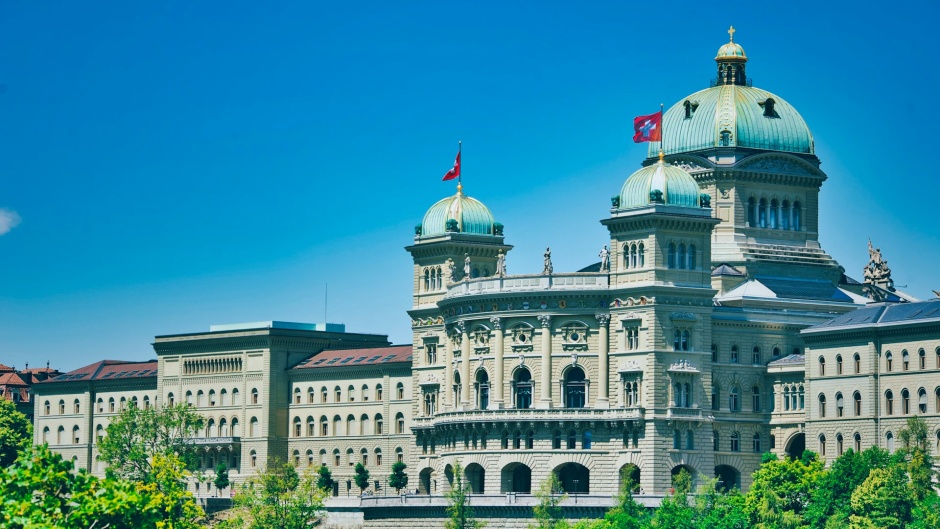 A view of the Swiss Federal Parliament buildings, in Bern. / Photo: [link]Andres Fischinger[/link], Unsplash, CC0.
Switzerland’s Federal Council (the national government) has rejected four motions from the ‘Egerkinger Committee’. The motions tried to address the activities of Islamic centres in towns, foreign funding and the question of the extent to which the state may treat faith groups differently.
The Federal Council rejected no fewer than four motions linked to the ‘Egerkinger Committee’, which were tabled by parlamentarians Thomas Knutti and Therese Schläpferm, both from the right-wing Swiss People’s Party (SVP).
All Evangelical Focus news and opinion, on your WhatsApp
Two of the rejected motions are ‘No controversial Islamic centres against the will of the local community’ and ‘Ban on the funding of mosques and Islamic prayer rooms by states that support terrorists, violate human rights and persecute Christians’ (the other two are ‘New Islamic centres, Muslim prayer rooms and mosques require a security check on the organising body’ and ‘Motion tabled: Transparent mosque funding builds trust’).
Concerning the issue of controversial Islamic centres, the twelve signatories had called on the Swiss government to make laws that ensure that mosques, Islamic prayer rooms and other Islamic centres get the consent of the local authorities concerned. “Swiss municipalities are fully within their rights to demand transparency regarding the funding and ideological background of Muslim institutions within their municipal boundaries. After all, it is they who are affected by the direct consequences”, they said.
The motion argues that involving local authorities in the authorisation process for mosques, Islamic prayer rooms and other Islamic centres strengthens the legitimacy of transparent, locally rooted projects. “In the face of projects with opaque funding, the right of local authorities to have a say fulfils an important protective function against foreign influence in Switzerland”.
The government did not support the proposal, arguing that the law regarding construction falls within the remit of the cantons (the Swiss regional departments). “The Federal Council sees no reason for the Confederation to encroach upon cantonal powers and grant municipalities additional authorisation powers”.
A requirement for the cities and towns to be able to stop the development of Muslim premises would contravene the prohibition of discrimination of the Swiss Constitution (Art. 8(2)), they added.
In the second motion, the committee called – in brief – for the Federal Council to introduce legal provisions prohibiting the funding of mosques and Islamic centres if the money comes from countries that are suspected of supporting terrorist organisations, violate human rights as set out in the Universal Declaration of Human Rights, persecute or oppress Christians on account of their faith, or permit such persecution.
Reliable information from recognised aid organisations, such as Open Doors’ World Watch List would serve as the basis for the classification of countries, the promoters said.
Here, too, the Federal Council has rejected the proposal, on the grounds, amongst other things, that a regulation affecting only Muslim places of worship would be a discrimination not allowed by the Constitution, adding that relationship between the state and religious communities is, in principle, a matter for the cantons - the Confederation can only intervene in cases involving significant threats to internal security or the functioning of the state.
Member of the national parliament Thomas Knutti, who tabled two of the rejected motions, told Swiss news website Livenet that he regrets the Federal Council’s decision: “The majority in Parliament likes to talk about a say in decision-making and local autonomy, but apparently only as long as it is politically convenient. If a local authority has practically no say in a major and controversial religious building project, that is not, in my view, local autonomy in practice”.
In that case, he added, “the local authority is affected but is not allowed to have a say. That is the wrong approach. I will continue to campaign to ensure that local authorities and the public are not simply presented with a fait accompli. Politicians must not look the other way on this issue. The problem has not gone away simply because the motion was rejected”.
The legislation that the Egerkine Committee (which presents itself as an initiative to “stop the Islamisation of Switzerland”) could affect other faith groups, admits MP Thoms Knutti.
“If we create a legal rule, it must apply equally to all religious communities. If a local authority is granted a genuine right to have a say in a major religious building project, then this right also applies to free evangelical churches, churches and other religious communities”.
He sees “no problem with the same rules applying to Christian free churches. Anyone who calls for equal treatment must demand it consistently for everyone. What matters is the scale and impact of a project on the local community. Freedom of religion does not mean that communities lose their democratic right to have a say”.
Another debate in several Swiss Cantons is that of Islamic head coverings.
At the end of August, the Aargau cantonal parliament passed a headscarf ban in schools for pupils up to the age of 16, by 78 votes to 54. As early as 10 June, the St. Gallen cantonal council (by 70 votes to 46) passed a headscarf ban for female teachers, and the canton of Zurich also decided (by 87 votes to 82) at the end of August to introduce a headscarf ban for female pupils and teachers.
Switzerland now has 6.2 per cent Muslims. In other parts of Western Europe, Germany and the UK each have 6.3 per cent, Austria 7.1 per cent and France 8.7 per cent.
Issues relating to Islam are increasingly becoming the focus of public interest in Switzerland.
A Christian with a different view is Michael Mutzner, director of the group ‘Christian Public Affairs’. We asked him about the motions about Islam that have been rejected by the Swiss government.
Question. The Federal Council argues that the state must not deliberately discriminate against any single religion. Why is this principle so central to the Federal Constitution?
Answer. Equal treatment of all religions is at the heart of our constitutional order. Article 8 prohibits discrimination on the grounds of religious beliefs, whilst Article 15 guarantees freedom of religion and conscience. The state must therefore not decide which religion deserves more freedom than another.
Today, such unequal treatment may affect Muslims; tomorrow, it may affect another minority – for example, Christians. As Christians in particular, we know how precious religious freedom is.
In 2008, the World Evangelical Alliance (WEA) expressly affirmed: this right is indivisible and cannot be claimed solely for a specific group. Religious freedom applies to everyone – or, ultimately, to no one.
Q. What consequences would a right of veto at local authority level have for religious minorities in Switzerland – not only for Muslims, but also for Christians, free churches or other communities?
A. The local authority already has a say in such matters today, and this is fundamentally legitimate. I can also understand the need for objective requirements regarding spatial planning, safety or financial transparency. A blanket political right of veto against new religious buildings, however, would be problematic. Such a restriction would have to meet the requirements of Article 36 of the Federal Constitution: it requires a legal basis, must serve the public interest and must be proportionate – that is, appropriate, necessary and as non-intrusive as possible.
If the right to have a say is directed expressly and exclusively against mosques, it violates the prohibition of discrimination set out in Article 8 of the Federal Constitution. If, on the other hand, it is formulated in a religion-neutral manner, it may equally affect churches, free churches, synagogues and other religious communities. Decisions on religious building projects should not be made on the basis of political sentiment, but according to clear criteria in accordance with the rule of law.
Q. Why should religious freedom be a concern for Christians when it comes to the construction of mosques?
A. On the one hand, Christians should be guided by love for their neighbour: I wish to grant others the same freedoms that I claim for myself. On the other hand, it is a matter of the limits of state power. In 1 Timothy 2, Paul calls on us to pray for those in authority, so that we may lead a quiet and peaceful life. In this, I recognise a central expectation of the state: it should guarantee a framework of freedom. Within this space of freedom, Christians can proclaim the Gospel. This first changes hearts and, from there, has an impact on society. Religious favouritism or discrimination must not be enforced from above by means of state power.
When I defend the religious freedom of those of other faiths, this does not mean that I regard their faith as a valid path to the truth or that I consider what they proclaim to be true. As a Christian, I am convinced that Jesus Christ is ‘the Way, the Truth and the Life’.
There is a well-known saying: ‘I do not share your opinion, but I will fight to ensure that you remain free to express it.’ This also corresponds to my understanding of religious freedom.
Q. Some Christians say: ‘Islam does not grant Christians religious freedom in many countries – why should we grant it here?’ How do you respond to that?
A. The principle of reciprocity does not convince me. Just because other states commit injustices, we should not do the same. On the contrary: Switzerland should demonstrate how a liberal constitutional state treats religious minorities.
We must not make our own values dependent on how other states act. This should go without saying, particularly for Christians. Paul and Peter both call, in the New Testament, not to repay evil with evil. The wrongdoing of others does not justify our own.
Q. Headscarf bans in schools have just been debated and, in some cases, imposed. What is your view on this?
A. I take concerns about political Islam or the potential coercion of girls seriously.
Nevertheless, I am critical of headscarf bans for schoolgirls, as they severely restrict their personal freedom of religion. The Federal Supreme Court has ruled that such a ban is disproportionate (see BGE 142 I 49).
The situation is different for teachers, given their role as state employees and their special position in relation to their pupils. The Federal Supreme Court has therefore upheld a headscarf ban for a primary school teacher in Geneva (see BGE 123 I 296).
Q. You have already observed collateral damage – take the ban on baptisms in Geneva, for example – what happened? Are there examples where laws directed against one religion were later applied against Christians as well?
A. The example from Geneva illustrates this mechanism very clearly. In 2019, the canton enacted a law on secularism following a debate that was, amongst other things, heavily influenced by fears regarding Islam. This law severely restricts religious ceremonies in public spaces. A religious community can only apply for a permit to hold such events if it has first been authorised to deal with the state.
The free churches do not currently have this status and are therefore unable to obtain a permit for baptisms in Lake Geneva. My own congregation is also directly affected by this.
In my view, these free churches are thus among the main victims of this law. This shows that regulations created for political reasons, particularly with regard to Islam, can ultimately affect everyone, especially the free evangelical churches.
Q. Which concerns held by Christians regarding Islam do you consider justified?
A. Concerns are justified where political Islam challenges our liberal legal system, where religious pressure is exerted on women or converts, or where extremism, anti-Semitism and violence are legitimised.
Non-transparent funding and the influence of foreign states must also be addressed. However, it is crucial to tackle specific problems in a targeted manner. Muslim women and men must not be placed under suspicion. We must distinguish between a critical examination of a religion and discrimination against its followers.
Q. Is there anything else worth mentioning?
A. The best Christian response to the competition between worldviews is not state bans, but the persuasive power and beauty of the Gospel. A vibrant Church need not fear other religions. It trusts that the truth will convince people through freedom.
This article was first published in German by Livenet, translated and adapted with permission.
[analysis]
[title] Do you see a need for this kind of journalism? [/title]
[text] Evangelical Focus is a network of many people in Europe and beyond who strive to bring a uniquely Christian perspective to the big issues of conversation.
Through news, interviews, opinion and analysis, we seek to build bridges between evangelical churches and the societies in which they live.
As a non-profit entity, the big challenge is to be sustainable, month by month. We invite you to make a difference! Join the readers who make Evangelical Focus possible.
[/text][/analysis]




Las opiniones vertidas por nuestros colaboradores se realizan a nivel personal, pudiendo coincidir o no con la postura de la dirección de Protestante Digital.


Si quieres comentar o