


Nearly thirty authors paint a diverse picture in the 500 pages of ‘Evangelicalism in Europe’ (Langham 2025), illustrating the presence of Christian faith communities in countries as diverse as Sweden, Romania, the United Kingdom, or Portugal.
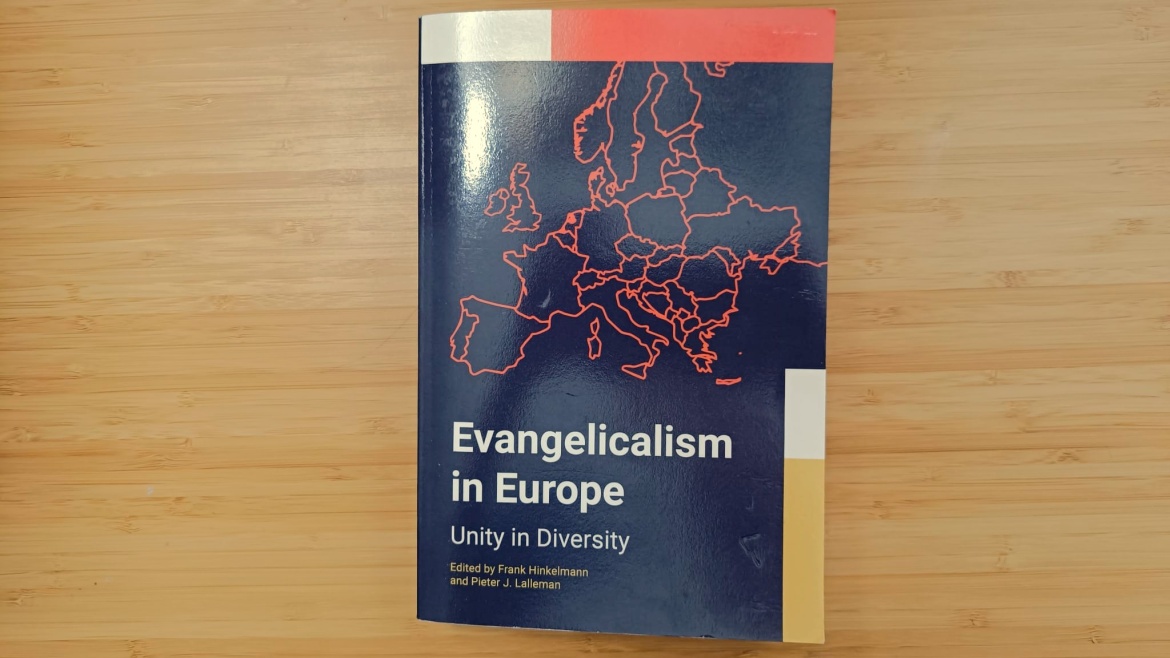 The book 'Evangelicalism in Europe' (Langham, 2025). / Photo: Evangelical Focus.
It has always been difficult to define who evangelical Christians are, both for outside observers and for insiders.
If we try to put the focus on Europe, it can get more complicated, given that the evangelical movement has often been projected in the media through the American experience or, more recently, interpreted through the rise of the Global South, the new missionary engine of the world.
All Evangelical Focus news and opinion, on your WhatsApp.
How many press reports have given a partial (if not intentionally sensationalist) view of evangelicals and their intentions, origins and practices?
That is why the book ‘Evangelicalism in Europe’, published in 2025 (Langham Global Library) and edited by the German Frank Hinkelmann (former president of the European Evangelical Alliance) and the Dutchman Pieter J. Lalleman (editor of the European Journal of Theology) is such a needed project. The editors have brought together no fewer than 27 other authors from across Europe to construct a mosaic of contemporary evangelicalism.
Despite its length, the 500-page work is easy to approach, as each chapter serves as a window into a different reality and can be read in 15 minutes or so.
After setting out the broad boundaries within which evangelical theology operates in the first third of the book, the reader will particularly enjoy delving into the finer details of the case studies of Austria, Croatia, the Czech Republic, France, Germany, Ireland, Italy, Norway, Portugal, Romania, Switzerland, Ukraine, the United Kingdom, Poland and Sweden.
Unsurprisingly, each author starts from a different point, as their denominational background (ranging from Pentecostal to Reformed, Baptist and Free Evangelical) and area of expertise (from theology to history to missiology) varies.
What the authors have in common is that they all participated in the Fellowship of European Evangelical Theologians (FEET) conference of August 2024 in Prague, entitled “Evangelical identity in Europe – unity in diversity”, which Evangelical Focus reported on at the time.
The evangelical faith, through its approximately 23 million believers in Europe, is in constant dialogue (or debate) with the cultural trends of this first quarter of the 21st century. Issues such as the influence of populist-nationalist movements on believers, racism, LGBTQI debates and the threat of a certain post-evangelicalism are also addressed in this book.
The authors also comment on the relationship between evangelical churches and other religious denominations (the ever-present questions when defining dialogue, ecumenism or co-belligerence), especially when the religious reality of Eastern Europe and the prominence of Orthodox Christianity is addressed.
Is it possible to define European evangelicalism in all its cultural, ecclesiological, missional, and theological diversity? Probably not, especially when we factor in the rapidly changing environment in which Generations Z and Alpha seem to be rediscovering spiritualities that their parents abandoned, and in which immigration over the last 50 years has redefined the very concept of church.
That is why a book like this, which from the outset speaks of evangelicalism as a broad, diverse, and highly culturally contextualised movement, is a good starting point for getting a taste of who these European Christians who continue to live out their faith in Christ, their rootedness in the Word of God, and their emphasis on mission, really are.
All evangelicals share a belief in the transformative power of Jesus' ‘good news’ and of the Holy Spirit, which can bring new life to everyone, starting with neighbours, then fellow citizens, and ultimately affecting the destiny of the entire continent.
That is why, in the year 2026, as the world rapidly evolves geopolitically towards an uncertain future, it is particularly interesting to better understand how this Christian grassroots movement, present in every corner of Europe, sees the world and remains confident that there is hope even amid the cultural storms of the present moment.
Joel Forster, journalist in Spain, director of Evangelical Focus.
[analysis]
[title]Join us to make EF sustainable[/title]
[photo][/photo]
[text]At Evangelical Focus, we have a sustainability challenge ahead. We invite you to join those across Europe and beyond who are committed with our mission. Together, we will ensure the continuity of Evangelical Focus and our Spanish partner Protestante Digital in 2025.
Learn all about our #TogetherInThisMission initiative here (English).
[/text][/analysis]






Las opiniones vertidas por nuestros colaboradores se realizan a nivel personal, pudiendo coincidir o no con la postura de la dirección de Protestante Digital.


Si quieres comentar o