


Upholding the worth and dignity of all human beings is hard work, but it is an essential part of our responsibility to represent Jesus in a hurting and divided world.
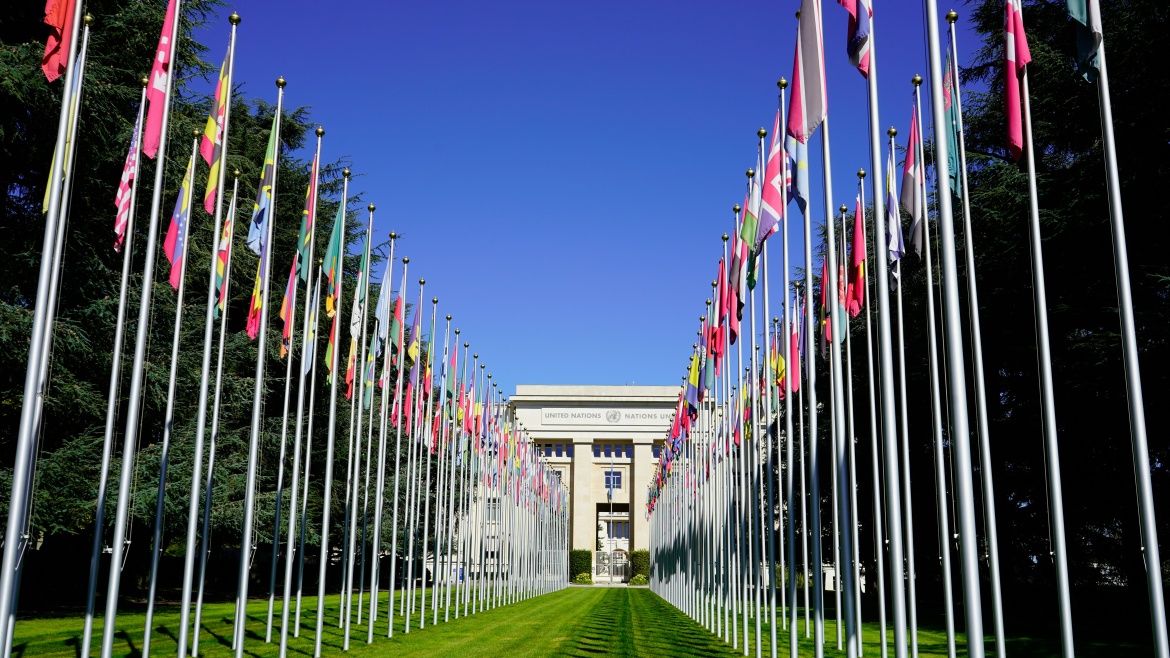 The Forum for Minority Issues was held at the Palais des Nations, in Geneva, Switzerland. Photo: [link]Meizhi Lang[/link], Unsplash CC0.
“How do you keep going?” asked the young, fresh-faced woman in the United Nations elevator. “I’ve been at this for three months and already feel like I am burning out!” That is the sad reality for many human rights advocates in this moment of global uncertainty in international relations. Christians working in this forum do not escape it either.
I recently spent two days at the Forum for Minority Issues, hosted in Geneva by the UN Special Rapporteur on Minority Issues. One purpose of this annual event is to give minority groups a platform to air their grievances.
And many of them, from all over the world, took advantage of the opportunity to describe their grief, pain, exclusion, and marginalization to the UN.
All Evangelical Focus news and opinion, on your WhatsApp.
Issues in Europe and the MENA (Middle East/North Africa) region were somewhat over-represented. This is largely because advocates had to fund their own travel to the forum, making the costs greater for people from Latin America or South and East Asia.
We did hear from people who came from various Asian countries, including Pakistan, India, Sri Lanka, Nepal, Bangladesh, China, Thailand and Vietnam.
Unfortunately, some of the most egregious violations of human rights were not represented because the victims are voiceless. For example, no one was present in Geneva to speak for the repressed women in Afghanistan.
Country representatives were on hand as well, ready to defend their own actions and point to the minority groups as the problem. China and Iran were especially vigilant in intervening whenever an advocate expressed criticism of human rights in their countries.
This whole exercise illustrated the status of human rights in the world today. Every country wants to portray itself as a model of social harmony and tolerance. But that is often not the reality for minority groups.
In my work for the World Evangelical Alliance, I advocate primarily for religious minorities. Christians are a minority group in most of the 161 countries where the WEA has national alliances. Often, they face severe restrictions on practicing their faith.
In Turkiye, for example, the approximately 7,000 evangelical Christians, out of a total population of 85 million, are hardly a threat, yet the government declines to recognize them.
Evangelicals in Turkiye cannot get permits to build new churches. Since they don’t have their own seminary, they have historically relied on pastors from other countries, but last year the Turkish government expelled foreign pastors, even those with Turkish spouses and families. As a result, many evangelical Christian churches are now without pastors.
In many Islamic countries, the historic Christian population, such as the Coptic Church in Egypt or the Armenian Church in Iran, is recognized and protected. But evangelical Christians are seen as a threat to Islam because they share the gospel energetically and are making converts.
In most countries where Islam is the official religion, it is illegal for Muslims to convert to another faith and Evangelicals have no legal status. These countries claim that they respect Christian minorities, but that is only partly true.
Conversely, several Muslim groups raised concerns about violations of the rights of Muslims who have immigrated to Europe and North America.
In some countries, followers of Islam are denied the right to wear distinctive clothing or accommodation of their holy days.
These cases remind us that human rights apply to everyone, all the time.
In virtually every country around the world, even those that see themselves as models of human rights, there are aggrieved minorities. In contrast, where the principles of human rights are observed consistently, no one is “othered” or excluded.
Lest we think that human rights are just an idea that the United Nations invented, Jesus said that God’s second-greatest commandment is to “love our neighbors as ourselves” (Mark 12:31).
He illustrated this point with the parable of the Good Samaritan, in which a member of a hated minority exhibited sacrificial love for a man left for dead at the side of the road.
Jesus made it clear that his mission included reconciling Jews and gentiles in John 10:16, “I have other sheep that are not of this sheep pen. I must bring them also. They too will listen to my voice, and there shall be one flock and one shepherd.”
Paul reinforced this message in Ephesians 2:15-18. He and his fellow Jewish Christians set an example for the church by recognizing that God welcomed believers from all ethnic groups in his kingdom.
It is not surprising, then, that Christians had a significant role in the development of the Universal Declaration of Human Rights (UDHR), the anniversary of which we celebrate each December 10.
When adopted in 1948, the UDHR was a groundbreaking global pledge in the wake of the atrocities of World War II. Our belief in the inherent dignity of all human beings as made in God’s image, regardless of any personal characteristics, is reflected in our robust recognition of human rights.
On this Human Rights Day, may we all reaffirm our commitment to upholding the worth and dignity of all human beings.
Yes, this is hard work. It can easily lead to burnout, because of the opposition human rights advocates face from many directions. But it is an essential part of our responsibility to represent Jesus in a hurting and divided world.
Janet Epp Buckingham, Director of the World Evangelical Alliance Office to the UN in Geneva.





Las opiniones vertidas por nuestros colaboradores se realizan a nivel personal, pudiendo coincidir o no con la postura de la dirección de Protestante Digital.


Si quieres comentar o