


Sculptress Alicia Eggert arrests us in Amsterdam with her interplay between physics and philosophy. It is a simple physical fact: light travels at a finite speed.
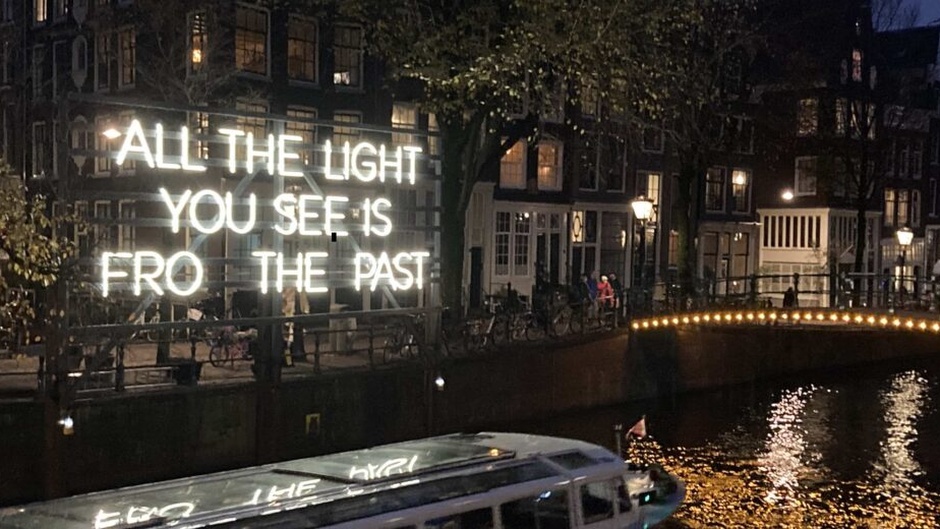 Photo via: [link]Weekly Word[/link]
Amsterdam’s Light Festival lit up the city’s canals this week with works by artists from around the world.
One thought-provoking light-sculpture took on particular relevance with world affairs this past week. A neon sign flashed on and off to reveal the phrases ‘All the light you see is from the past’ and ‘All you see is past’ before turning off completely for a short time.
Texan sculptress Alicia Eggert arrests us with her interplay between physics and philosophy. It is a simple physical fact: light travels at a finite speed. Every sunbeam that reaches our eyes and makes the reality around us visible has taken eight minutes to get here.
All Evangelical Focus news and opinion, on your WhatsApp.
The nearest star’s light is four years old. Many galaxies that dazzle the night sky sent their photons toward us millions or billions of years ago. The universe we see is never the universe as it is, but always the universe as it was.
Here is a profound metaphor for human life. If all light comes from the past, then so does almost all the illumination by which we try to understand our political and moral reality.
The insights that guide us do not arrive fully formed in the present moment. They emerge from accumulated experience, from memory, from stories and struggles that preceded us. The light we use to navigate today’s crises is the light generated by earlier generations, earlier choices, earlier mistakes.
Modern societies, however, often imagine they can operate in an eternal present—powered by data, technology, or economic might. But this illusion is as dangerous as walking at night without a lamp. History is not a burden; it is a source of illumination. To ignore it is to walk blind.
First, history gives us context, without which our judgments become shallow. Every nation is shaped by layers of memory—trauma, triumph, injustice, renewal—that continue to influence the present. Without knowing these layers, we misinterpret events, misunderstand motivations, and misread risks.
No contemporary conflict or political crisis can be understood by the headlines of the last 24 hours alone. To observe the present without history is to mistake shadows for reality. Leaders without historical awareness, or who deliberately distort the narrative, are dangerous.
Second, history reveals patterns. Human societies do not behave randomly; they repeat behaviours. Aggressors test boundaries. Appeasement emboldens the powerful. Democracies become complacent. Economies that marginalise the vulnerable sow instability.
Leaders who ignore these patterns are like astronomers who refuse to learn from the dependable behaviour of stars: they watch the same phenomenon again and again without recognising its meaning.
Third, history offers moral and strategic warning signs. When leaders fail to read those signals, the cost is paid in human lives. This is why the metaphor of light is so powerful: history does not simply inform; it warns. It allows us to see dangers before they collide with us.
Here’s where we can see the relevance of the Bible for modern life. It is not merely a spiritual text; it is an historical record—one that spans centuries of human decisions, failures, betrayals, reconciliations, renewals, and restorations.
The Bible is the only sacred book that takes history seriously. Both the Old and New Testaments start with historical books explaining what God has done in the past, before moving on to books that tell us how to live in the present, and then about what we can expect God to do in the future.
Biblical history shows, for example, how nations fall when leaders pursue power without righteousness. It shows how societies unravel when truth is discarded, when the weak are exploited, or when leaders trust in chariots rather than principles.
It records what happens when peace is sought without justice. At the same time, it illuminates how communities are renewed through repentance, how justice restores trust, and how humility opens the door to genuine reconciliation.
These are not merely religious lessons; they are political and social truths validated repeatedly across human history.
Right now, the need for historical and biblical light is especially acute. We face political polarisation, geopolitical tensions, democratic backsliding and moral confusion. Peace plans are proposed that ignore earlier betrayals; authoritarian ambitions are underestimated despite clear precedents; and societies are tempted to sacrifice justice on the altar of short-term stability.
These failures are not due to lack of intelligence. They stem from acting without illumination—historical or biblical.
All the light we see comes from the past. It is a scientific truth, but also a historical and spiritual one. If we want to act with wisdom, pursue justice and build peace, we must draw on light from the accumulated lessons of history and the ancient light of Scripture.
Jeff Fountain, Director of the Schuman Centre for European Studies. This article was first published on the author's blog, Weekly Word.






Las opiniones vertidas por nuestros colaboradores se realizan a nivel personal, pudiendo coincidir o no con la postura de la dirección de Protestante Digital.


Si quieres comentar o