



In a survey published by the Theos think tank, more than a third of respondents said they agree with the so-called ‘Great Replacement theory’, which claims that Europe’s population is being deliberately replaced by Muslim immigrants.
.jpg)
Evangelicalism cannot be ignored. If you meet three people who practice their Christian faith, go to church, read the Bible and pray, then two of them are likely to be evangelicals.

The 74 per cent increase in baptisms over the last four years is the clearest sign of a shift in trend across its more than 500 churches, explains the Federation of Free Evangelical Churches in Germany.
.jpg)
While people expect the church to offer easily digestible products that can keep pace with the entertainment market, each individual remains the center of their own life, and the church is a convenient afterthought.
.jpg)
He began exploring Minecraft after officiating at the funeral of a parishioner who had been an active player. Members of the man's online gaming community showed up to say goodbye. Shortly afterward, he created an account himself.
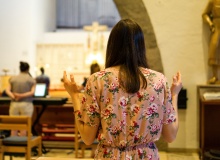
Government statistics from 2026 show that 40% of people identify as “nones”. Although church weddings continue to decline, more young people say they believe in God.

A new report shows that 41% of people under the age of thirty want to learn more about the Bible. Surprisingly, a third of men say they have attended at least one church service in the last month.

For the first time since 1998, the proportion of people who do not attend religious services outnumbers those who attend occasionally.

The number of mainline Protestants and Roman Catholics has fallen to 19% and 30%, while free evangelicals remain stable at 6%.

Our churces should promote spaces where generations can coexist, interact, and build deep, lasting bonds with each other, strengthening a sense of belonging.

A Pew Research Center survey shows that ‘nones’ in Europe “are much less inclined” to believe in God, and “tend to voice negative views of religion”.
Cropped(1).jpg)
Creating a space to listen to stories and extend grace can be redemptive in a way that well worded arguments fail to match.

Religious marriages fall to a quarter of the total at the beginning of the century and the presence of Catholicism in public schools is reduced by half.
.jpg)
A survey by the Evangelical Alliance shows that “overall church attendance increased by 13% between 2020 and 2025”. The number of people coming to faith has doubled, and church members are more willing to share the Christian message with others than they were before 2020.
.jpg)
The increase in young men is fivefold, and 37% of all those under 24 say they are curious about the Bible. The YouGov study points to a steady decline in nominal Christianity but faith is becoming “even culturally attractive”.
.jpg)
Christians who go to church and read the Bible at least once a week give 11% of their income to charity, compared to 2% of the rest of population. “A commitment to a Christian faith doesn’t preclude supporting causes that are not explicitly driven by faith”, the survey finds.

The survey shows that the majority of Catholics are 55 or older, while the highest percentage of evangelicals are between 18 and 24 years old.

There are reports of a renewal in church youth work from all over Scandinavia. What could Jesus contribute as an influencer in this context?

If the integration process in the big city is not successful, we risk losing several generations of young people who will live their spirituality away from the local church. By Ismael Rodelgo.

Data from a state survey show that the number of evangelicals remain stable, while the Catholics are declining.
.jpg)
Members of Generation Z would be the most interested in opening up the Scriptures.
.png)
Some churches are wondering how to “secure their future in a denominational structure that is moving away from them theologically and ethically”, says an Anglican minister in Newcastle.
.jpg)
Half check the website of their local church on a regular basis and 24% follow Christian influencers, finds a study.
.jpg)
Reinhardt Schink of the Evangelical Alliance says “forms of church can be adapted” but warns against decisions that strengthen individualism and “weaken the community of believers”.

Research looks at how the young in France see secularism. People between 18 and 30 are more tolerant of religious symbols in public.






Las opiniones vertidas por nuestros colaboradores se realizan a nivel personal, pudiendo coincidir o no con la postura de la dirección de Protestante Digital.

