


At a time of intense media coverage, Spanish evangelicals welcome analysis but ask that people avoid stereotyping regarding the voting habits, background or identity of their faith minority.
 A worship concert at a recent evangelical event in Madrid, Spain. / Photo: [link]The Change Madrid[/link].
The Spanish Evangelical Alliance has issued a statement expressing its views on the growing number of news reports, features and opinions concerning the evangelical community in Spain.
“We welcome the fact that an increasingly visible social reality is the subject of public attention, understanding that no community should be exempt from evaluation or criticism”.
The evangelical body also expressed concern about the media coverage of this small faith minority of around 3% of the population in Spain. “In certain news reports and public comments, the analysis leads to oversimplifications, caricatures or sweeping dismissals” that do not help to understand the reality of the Spanish evangelical world.
All Evangelical Focus news and opinion, on your WhatsApp.
It comes just a few days after a large-scale event held in Madrid that caused a media controversy. In addition, a prime-time television documentary on neo-Pentecostalism in Catalonia has recently been broadcast.
According to official data, evangelical Christians had 4,763 worship places in Spain at the end of 2025. They are the largest faith minority, ahead of Islam.
The full text of the statement, published on 8 May, is reproduced below.
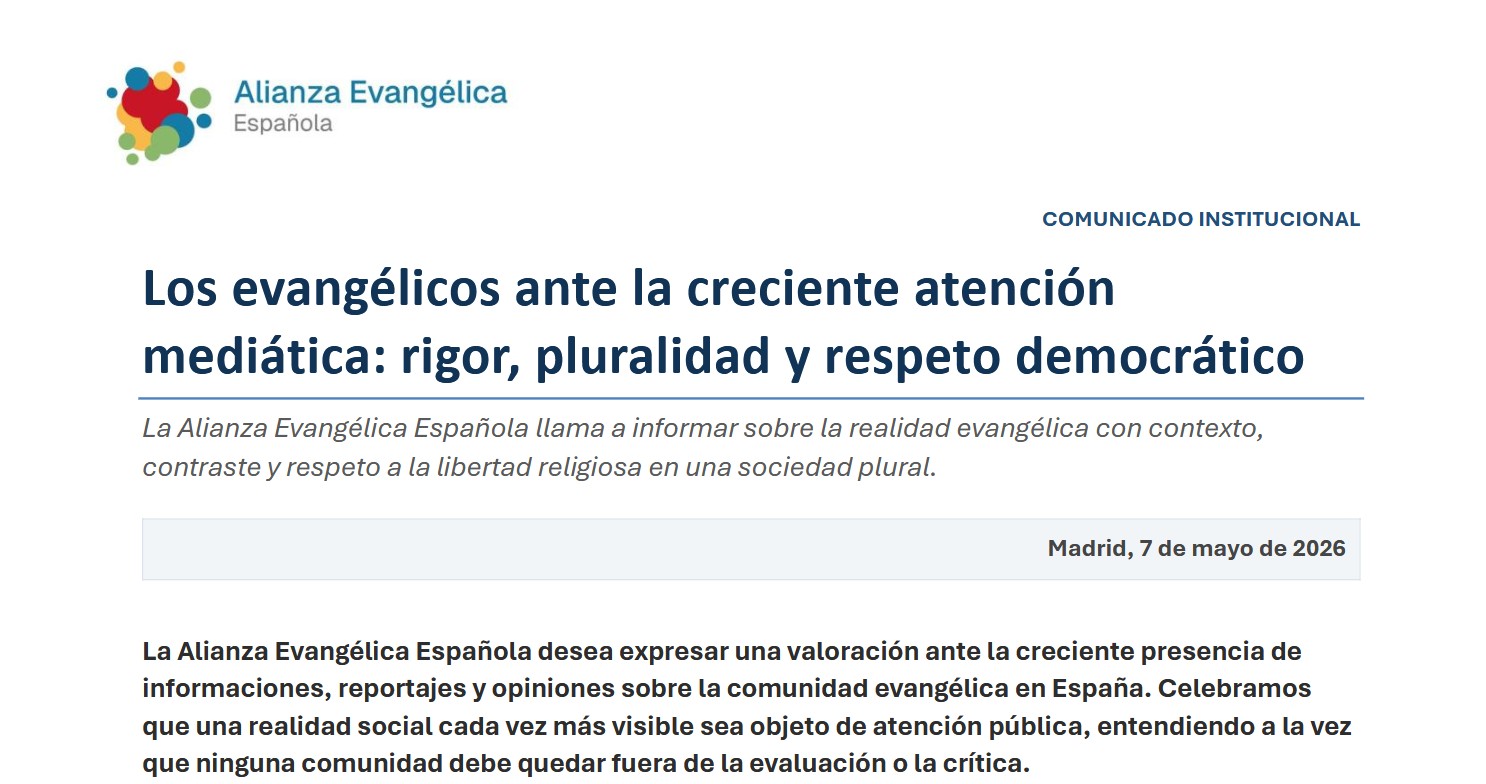
[photo_footer] Statement of the Spanish Evangelical Alliance of 7 May 2026, on media coverage and evangelical diversity. [/photo_footer]
1. Religious freedom and public presence
It is legitimate for evangelical churches, their public acts, their messages and their forms of social presence to be analysed, discussed and even criticised. Freedom of expression also protects uncomfortable or even irreverent opinions. Democratic life itself demands that religious convictions, like any other worldview, can be scrutinised in the public sphere.
What is worrying is not criticism, but unfair generalisation; not the analysis, but the caricature. In some cases, the evangelical faith is presented as a homogeneous, exotic, suspicious or culturally alien reality, when in fact we are talking about a plural, deeply rooted, diverse community made up of citizens with the same rights and duties as the rest of society.
The fundamental question is simple: do evangelical citizens have the same right as other groups to express themselves publicly, assemble peacefully, celebrate their faith, defend their way of life and legitimately occupy a visible space in society? From a democratic and constitutional perspective, the answer must be unequivocal: yes.
Religious freedom is not merely the right to believe in private. A pluralistic society is one that allows different beliefs, ideologies or worldviews to be expressed within the same legal boundaries and with equal public dignity, and not one that confines religious convictions to the strictest privacy.
For this reason, we defend both the media’s freedom to report, interpret and criticise, and the need for that freedom to be exercised with rigour and balance. Reporting on a religious minority requires avoiding the shortcut of stereotyping, listening to diverse sources, and not turning specific incidents, particular sensitivities or partial images into a complete portrait of an entire community.
2. Evangelical churches, immigration and integration
A significant proportion of the migrant population, particularly those of Latin American origin, find in evangelical churches spaces for community, companionship, a sense of belonging, emotional support, music, support networks and social participation. Viewing this reality as a problem demonstrates an inability to address the phenomenon of immigration constructively and democratically and borders on xenophobia. In fact, the presence of the migrant population in evangelical churches constitutes a pathway to integration, rootedness, mutual care and civic participation.
Instead of resorting to oversimplification and caricature to demonise the evangelical community, we invite the public to discover and evaluate it with professional rigour. This will lead to the revelation of an exemplary phenomenon: namely, that we evangelicals are finding success where many sectors of society fall short—in integrating immigrants in a manner that is mutually respectful, free, responsible and enriching. And we do so by drawing on a deep spiritual identity that transcends cultural barriers and places immigrants and locals on an equal footing—a model that is rarely achieved in other social settings. We put into practice the biblical principle: “You shall have the same law for the stranger as for the native-born, for I am the Lord your God” (Leviticus 24:22).
Evangelical churches with a Latin American ethos, in all their diversity, do not conform to a single image nor can they be treated as a uniform bloc. As in any broad social reality, there are different styles, trajectories, accents, forms of worship and degrees of institutionalisation. Reducing that diversity to a grotesque caricature impoverishes the analysis and fuels prejudice.
It is not legitimate, in terms of democratic coexistence, to treat thousands of citizens as suspects on account of their faith, their origin or their way of worship. Nor is it legitimate to describe them as uneducated, fanatical, undesirable foreigners or inferior people simply because they are Evangelicals, Latinos or believers.
The Spanish evangelical community cannot be explained solely through the lens of immigration, although the contribution of migrants is valuable and enriching. There is a historical, cultural, social and institutional roots of Protestantism in Spain, with representative bodies, regional councils, local churches, social welfare organisations, educational initiatives, media outlets and spaces for public dialogue.
In this sense, the presence of believers from different backgrounds within evangelical churches and organisations should not be presented as a threat, but as a concrete expression of a more diverse Spanish society. The challenge is not to render that diversity invisible, but to understand it correctly and describe it fairly.
3. Evangelicals and politics
We are also concerned about the tendency to present the evangelical vote as a uniform vote or one automatically aligned with a specific ideological stance, particularly when it is generically identified with what is known as the “far right”. This interpretation does not correspond to the actual plurality of evangelical churches nor to the diversity of social sensibilities and political positions of their members.
There is no single ‘evangelical vote’. Evangelical churches do not act as a transmission belt for any political party. The representative bodies of the evangelical community maintain that no party, leader or programme fully exhausts or represents the Christian ideal. Every believer must evaluate, in good conscience and responsibly, the overall agenda, programmes, proposals and actions of each political option.
The vocation of the Spanish Evangelical Alliance and the evangelical community in public life is to maintain dialogue with all political forces, without identifying with any one of them. This relationship must be developed on the basis of mutual independence: independence of the churches from the parties and independence of the parties from the churches.
That very independence allows us to support, endorse or reject specific political actions wherever they may come from, always on the basis of ethical, social and democratic reflection, and not out of obedience to party slogans. The evangelical public presence does not seek privileges, but rather the recognition of rights and respect for freedom of conscience.
We evangelicals are not newcomers who have only recently joined democratic society. In fact, as is well known, Protestantism has been a driving force behind democratic freedoms for over five centuries. And in Spain, we Evangelicals have been demanding freedom of conscience, expression and assembly for over a century; the Spanish Evangelical Alliance itself emerged at that time as a means of fighting for those freedoms when few others were demanding them.
4. A call for rigour and a willingness to engage in dialogue
The Spanish Evangelical Alliance calls upon the media, analysts and public officials to ensure that the reality of the evangelical community is addressed with rigour, a plurality of sources and respect. Journalism plays an essential role in democracy, especially when it helps to understand complex social phenomena without reducing them to clichés.
We ask that a distinction be made between information and stereotype, between legitimate criticism and cultural contempt, between analysis of specific facts and the blanket dismissal of a faith community. We also request that, when discussing the evangelical world, its representative bodies, its churches, its charitable organisations, its academics and its diverse voices be consulted.
Democratic pluralism does not mean that all convictions disappear from the public sphere, but rather that all may be expressed within the common framework of the law, fundamental rights and respect for human dignity. In such a pluralistic society, we Evangelicals wish to continue contributing our faith, our ethics, our social action, our community life and our commitment to the common good.
The Spanish Evangelical Alliance will remain open to dialogue with journalists, institutions, political parties, universities, social organisations and the public. We Evangelicals have nothing to hide; we are open to being held to account in the light of truth, for “we can do nothing against the truth, but only for the truth” (2 Corinthians 3:18). We encourage the media to apply this same standard. The Spanish Evangelical Alliance openly offers to collaborate in this task; we do so out of the conviction that religious freedom and freedom of expression are common goods that we must protect together through democratic respect.
[analysis]
[title] Do you see a need for this kind of journalism? [/title]
[text] Evangelical Focus is a network of many people in Europe and beyond who strive to bring a uniquely Christian perspective to the big issues of conversation.
Through news, interviews, opinion and analysis, we seek to build bridges between evangelical churches and the societies in which they live.
As a non-profit entity, the big challenge is to be sustainable, month by month. We invite you to make a difference! Join the readers who make Evangelical Focus possible.
[/text][/analysis]






Las opiniones vertidas por nuestros colaboradores se realizan a nivel personal, pudiendo coincidir o no con la postura de la dirección de Protestante Digital.


Si quieres comentar o