


The book Francoism against Protestants uncovers forgotten stories of repression during the Franco dictatorship, shedding light on the past and present of evangelical communities in Spain.
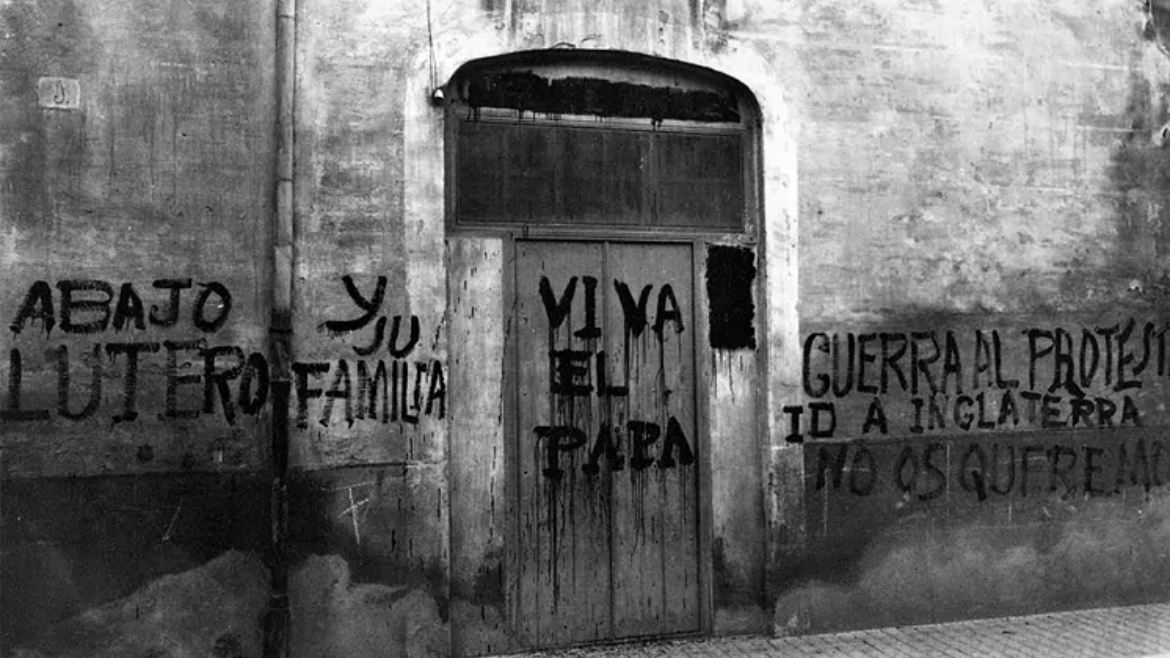 The Baptist church in Figueres vandalised with graffiti in 1948 / Photo: Evangelical Graphic Documentary Archive (AGDE)
After the failure of the coup d'état in Spain on 18 July 1936, the rebel troops began a three-year war.
On 14 April 1939, the victory of Francisco Franco's troops over Spanish territory consolidated the establishment of an authoritarian, personalist regime. Franco's dictatorship lasted until his death on 20 November 1975.
To coincide with the 50th anniversary of the dictator's death, a book has been published that aims to recount the stories of the repression and resilience experienced by Protestants during that period of Spanish history.
All Evangelical Focus news and opinion, on your WhatsApp.
The book's title, El Franquismo contra los Protestantes (Francoism against Protestants), makes it clear that this repression also extended to Spain's 'grandparents in the faith', as the author, Luis Mas, calls them.
Its pages tell the stories of lives cut short by imprisonment, exile or execution that have been overlooked in history books.
Stories that have also largely gone unnoticed in Protestant seminary lessons. Stories seemingly condemned to silence, perhaps out of fear of reopening wounds that have not yet healed.
Above all, these are essential stories for understanding the past and present of Spanish evangelical communities.
Spanish news website Protestante Digital, spoke with Mas, a historian, and Carles Raurell, a contributor to the book, about some of the topics and stories covered in the book, as well as the documentation and editing processes.
Article 3 of the 1931 Republican Constitution confirmed that Spain had no official religion, while Article 26 guaranteed that all religious denominations would be considered associations subject to special legislation.
This, along with the freedom of conscience and religion enshrined in Article 27, enabled Protestants in Spain to live, express and share their faith freely, which would have been unthinkable under the previous Roman Catholic-based state regime.
“Protestants supported the Republic because the Second Republic gave them the freedom to meet and open places of worship”, said Raurell in the interview.
For the author of the book, this meant that “Protestantism at that time was involved and influential in society”.
By contrast, the Catholic Church lost much of its influence during the Republican period.
Wherever the coup succeeded in 1936, and in the rest of the territory once the rebels had won, the Catholic Church “became an informer on pastors who were socially committed, had been teachers, or had been involved in trade unions or politics”, pointed out Mas.
Spanish Protestantism lost some of its most valuable figures: people committed to improving society and bearers of ideas that were ahead of their time.
Many evangelical leaders suffered repression through executions, exile, deportation, imprisonment, forced labour or purging from their professions.
Meanwhile, churchgoers were forced to meet in their home, risking complaints from their neighbours.
The book features the stories of José Nogal, Simón Vicente Vicente, Elías Marqués and José Cardona Gregori, who would later become the Executive Secretary of the Evangelical Defence Commission.
It is important to read and share these stories so that we do not lose the memory of those who came before us, nor the legacy of faith, commitment and resistance that helped to build our communities amidst persecution.
However, this book is only a 'seed', the first step in a research project that will pave the way for others to build on it.
[analysis]
[title]Join us to make EF sustainable[/title]
[photo][/photo]
[text]At Evangelical Focus, we have a sustainability challenge ahead. We invite you to join those across Europe and beyond who are committed with our mission. Together, we will ensure the continuity of Evangelical Focus and our Spanish partner Protestante Digital in 2025.
Learn all about our #TogetherInThisMission initiative here (English).
[/text][/analysis]





Las opiniones vertidas por nuestros colaboradores se realizan a nivel personal, pudiendo coincidir o no con la postura de la dirección de Protestante Digital.


Si quieres comentar o