


Last week in Warsaw, I was deeply moved by the story of Jerzy Popiełuszko, a hero of the Polish resistance to the communist regime. The relevance and urgency of his message for all victims of injustice today is clear.
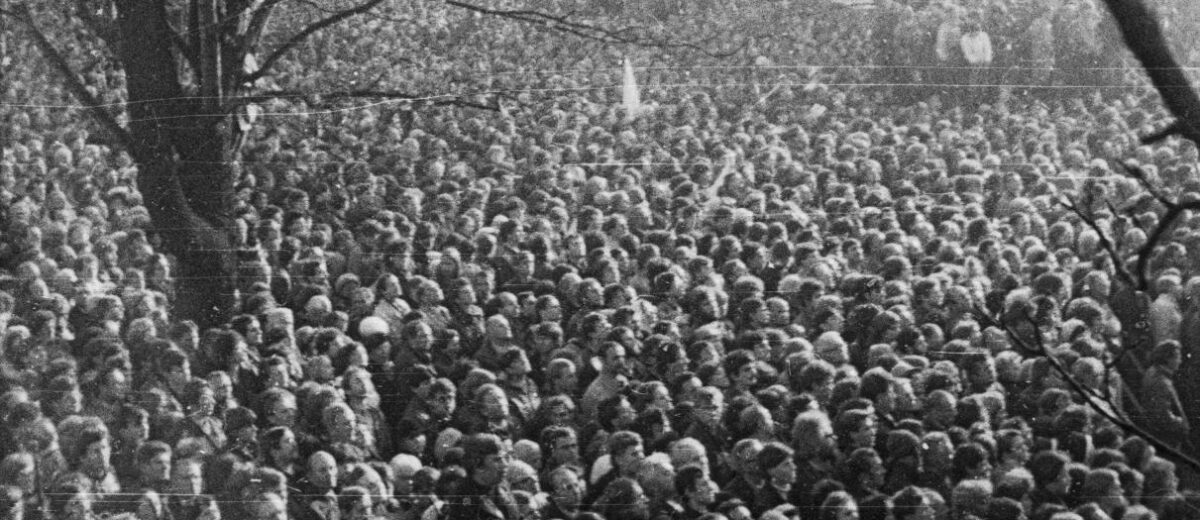 Hundreds attended the funeral of Jerzys. / Photo via [link]Weekly Word[/link].
The exemplary life, inspired teaching and violent murder of a Polish priest forty-two years ago offers hope for Ukrainians and Europeans troubled by injustices, whether emanating from Moscow or Washington.
This Monday is the anniversary of the abduction, torture and brutal murder of Father Jerzy Popiełuszko, a thirty-seven-year-old priest esteemed as the soul of the ‘Solidarity’ trade union of Lech Walesa.
For on 19 October 1984, Polish security officers threw his body weighed down with rocks into the Vistula River.
All Evangelical Focus news and opinion, on your WhatsApp
His battered body was later recovered and buried in the presence of over half a million Poles in the grounds of his parish church, the largest funeral in Poland’s history. They could silence his voice, but not his witness.
Last week in Warsaw, I was deeply moved by the story of this hero of the Polish resistance to the communist regime. The relevance and urgency of his message for all victims of injustice today became very clear as our guide told his story.
After attending a parliamentary prayer dinner and prayer breakfast with Polish politicians, I joined other international guests to visit Father Jerzy’s church in the suburbs of Poland’s capital where his remains lie buried under a large stone cross-shaped grave.
We heard how this humble, unassuming young man from Poland’s countryside emerged as a towering beacon of hope for millions as the chaplain to the ‘Solidarity’ movement.
In the basement museum under the church, we learned how he championed truth, peace, forgiveness, love for one’s enemies and the value of human dignity in the face of the hatred and violence of totalitarianism.
He consistently proclaimed the Gospel in word and deed through sermons, prayer and solidarity with people whose dignity the communist state violated.
When I first visited Warsaw to address a student conference in May 1981, the ‘Solidarity’ trade union was growing rapidly across the nation, encouraged by Pope John Paul II. Red-and-white Solidarnosc posters were everywhere in the city.
The term ‘solidarity’ holds a central place in Catholic social teaching. More than merely compassion or a charitable response to suffering, it is a moral virtue, a principle for organising society, and a Christian responsibility to work for the good of all people, the common good.
We may feel distressed, for example, by the suffering of Ukrainians, persecuted Christians, refugees or people living under authoritarian regimes. Solidarity involves a sustained commitment to their good.
A communal responsibility requires churches, associations and professional networks to act together. It carries a political responsibility to challenge unjust laws, institutions and international relationships.
It demands perseverance, continuing to act when the initial emotion or public attention has faded.
Popiełuszko embodied this understanding. ‘Solidarity’, he preached, ‘is a unity of hearts, minds and hands, rooted in ideals capable of transforming the world for the better.
It is a duty to eradicate evil. It is the preservation of inner freedom even amidst external subjugation. It is overcoming the fear that constricts the throat. It is upholding one’s dignity – the dignity of a child of God.’
In November 1981, martial law was declared by the communist authoriites, and ‘Solidarity’ was outlawed. Father Jerzy became a target of systematic violence and intimidation by the Security Service.
A brick carrying an explosive device was thrown into his apartment. His life was threatened. His car was tampered with. Despite all, he continued holding Masses for Homeland attracting many thousands to his church to hear human rights and justice defended publicly. Speaking truth together became an act of liberation.
Fr Jerzy prayed for those ‘who serve falsehood and injustice’. He urged his listeners not to succomb to fear, but to fight with love, justice and truth, declaring: ‘We will win, even if this fight lasts a long time.’
It was not enough for a Christian merely to condemn evil, falsehood, cowardice, subjugation, hatred and violence, he insisted. A Christian must be a true witness, advocate and defender of justice, goodness, truth, freedom and love.
Popiełuszko’s first lesson for us today is that freedom begins with refusing falsehood. That means rejecting convenient misinformation, scrutinising official claims, challenging policies that sacrifice vulnerable people to political advantage. It means holding leaders accountable.
His second lesson concerns courage. Authoritarian power feeds on the expectation that ordinary people will remain isolated and afraid. People become braver when someone stands beside them.
His third lesson is the hardest: overcome evil with good (Romans 12:21). At his final service, he urged freedom from fear and the desire for revenge. He challenged every defender to preserve humanity: protect civilians, treat prisoners humanely, reject torture and resist collective hatred.
Finally, martyrdom teaches us to measure success beyond immediate outcomes. Popiełuszko died before Poland recovered political freedom. His death offers no guarantee that goodness will prevail quickly, or that faithful people will escape terrible loss.
For Ukrainians and Europeans, and for that matter Americans and Russians of good will today, the task is concrete: tell the truth, protect the threatened, organise solidarity, demand accountability and guard the heart against hatred.
Jeff Fountain, Director of the Schuman Centre for European Studies. This article was first published on the author's blog, Weekly Word.
[analysis]
[title] Do you see a need for this kind of journalism? [/title]
[text] Evangelical Focus is a network of many people in Europe and beyond who strive to bring a uniquely Christian perspective to the big issues of conversation.
Through news, interviews, opinion and analysis, we seek to build bridges between evangelical churches and the societies in which they live.
As a non-profit entity, the big challenge is to be sustainable, month by month. We invite you to make a difference! Join the readers who make Evangelical Focus possible.
[/text][/analysis]




Las opiniones vertidas por nuestros colaboradores se realizan a nivel personal, pudiendo coincidir o no con la postura de la dirección de Protestante Digital.


Si quieres comentar o