


Of course disabilities do create real limitations. Yet people who have learned to live with disability often develop qualities that others have had little reason to cultivate: resilience, determination, creativity, empathy and unusual powers of observation.
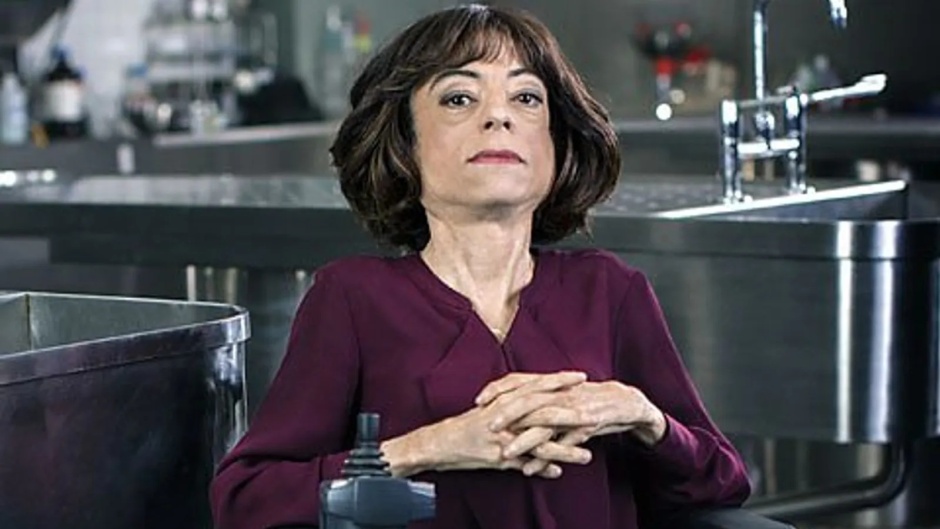 Clarissa Mullery, a forensic scientist who uses a wheelchair in BBC's Silent Witness series. / Photo: BBC.
What can church and mission leaders learn from British television detective dramas?
In a Zoom encounter this week with members of the European Disability Network, we noted the positive appearance of people with disabilities on detective programmes being portrayed as competent professionals.
Their particular gifts make them indispensable members of the team – instead of victims, patients or objects of pity.
All Evangelical Focus news and opinion, on your WhatsApp
[destacate]Prejudice has produced low expectations: the well-meaning assumption that people with disabilities should be cared for, rather than entrusted with responsibility[/destacate] In Silent Witness, Clarissa Mullery, a forensic scientist who uses a wheelchair, was valued for her sharp intelligence, expertise and wit. In Vera, Helen Milton’s role in intelligence and analysis demonstrated how a disabled professional could make a vital contribution to solving complex cases.
These examples teach us that disability does not define a character. A physical limitation is not the whole of a person’s story.
For too long, we have seen the wheelchair before the person, the learning difficulty before we discover their gifts. Prejudice has produced low expectations: the well-meaning assumption that people with disabilities should be cared for, rather than entrusted with responsibility.
Of course disabilities do create real limitations. Yet people who have learned to live with disability often develop qualities that others have had little reason to cultivate: resilience, determination, creativity, empathy and unusual powers of observation.
The detective who cannot run after a suspect may nevertheless see the clue that everyone else has missed.
How much human potential has society wasted by failing to see beyond the disability? How much human potential have we as church and mission leaders wasted by failing to see beyond the disability?
We have often thought primarily in terms of ministry to people with disabilities. We have asked how we can care for them, help them and include them. Which is good, but not sufficient.
We need to move to ministry with them, towards recognising and enabling ministry by them.
Our Christian faith gives us the strongest possible foundation for valuing every human being. For every person is made in the image of God.
Paul describes the church as a body in which even those parts that seem weaker are indispensable. He reminds us that God confounds the strong through the weak. Christian practice has often lagged behind Christian theology.
[destacate]Paul reminds us that God confounds the strong through the weak. Christian practice has often lagged behind Christian theology[/destacate] What gifts are we overlooking? What missionaries, evangelists, teachers, counsellors, intercessors and leaders are we leaving on the sidelines because our first question is about what they cannot do?
Romkje and I were invited to share what we had learned through our contact with the network members. Our first eye-opener was the sheer size of the disability community – Europe’s largest minority. One in four Europeans over 16 years have some sort of disability, according to the secular European Disability Forum. 100 million people!
We have learned to look at buildings, streets and footpaths, transport, toilet facilities and work stations in terms of accessibility and ease of passage. Actually, there is often more awareness in secular society than in the church of these needs.
Look at these principles of the United Nations’ Convention on the Rights of Persons with Disabilities (UN CRPD): • Respect for inherent dignity • Individual autonomy including the freedom to make one’s own choices • Non-discrimination • Full and effective participation and inclusion in society • Respect for difference and acceptance of persons with disabilities as part of human diversity and humanity • Equality of opportunity • Accessibility • Equality between men and women • Respect for the evolving capacities of children with disabilities and respect for the right of children with disabilities to preserve their identities.
Each of these rights is rooted in a biblical view of humans as created with dignity in the image of God.
[destacate]Instead of designing programmes for disabled people, we should design them with disabled people
[/destacate] We have come to see the need for a deep change to take place in leadership thinking. Instead of asking, ‘How can we accommodate this person?’ we should begin by asking, ‘What has God given this person that we need?’
This question moves disabled people from the margins to the centre. It stops seeing them merely as recipients of ministry and recognises them as contributors to the mission of God.
Instead of designing programmes for disabled people, we should design them with disabled people. Instead of assuming that accessibility is a charitable extra, we should regard it as part of good leadership.
[destacate]Without the gifts of disabled folk, the body of Christ does not function fully[/destacate] Instead of protecting people from responsibility because of perceived limitations, we should create pathways into responsibility. And provide support to allow their gifts to flourish.
We thought of examples of disabled people with outstanding ministries.
Joni Eareckson Tada. Paralysed from the neck down after a diving accident as a teenager, she has influenced millions through her books, speaking, broadcasting and advocacy for people with disabilities.
Nick Vujicic, the Serbian-Australian evangelist born without arms or legs. His ‘insurmountable limitation’ has became inseparable from a global ministry of hope.
Benny Prasad, an Indian musician and evangelist born with serious physical disabilities, has set a world record for the fastest time to visit all 245 countries and territories with his unique bongo guitar, carrying a message that challenged assumptions about what a disabled person could achieve.
We listened spell-bound as Beulah from Zambia told us on the zoom how, after contracting polio as a 6-year old, her father carried her on his back on his bicycle 10 kilometres to school and back every day, giving her dignity and confidence that she was worth investing in. She has ministered now in 25 nations, presently working in Germany.
So here’s the irony: without the gifts of disabled folk, the body of Christ does not function fully.
Jeff Fountain, Director of the Schuman Centre for European Studies. This article was first published on the author's blog, Weekly Word.
[analysis]
[title] Do you see a need for this kind of journalism? [/title]
[text] Evangelical Focus is a network of many people in Europe and beyond who strive to bring a uniquely Christian perspective to the big issues of conversation.
Through news, interviews, opinion and analysis, we seek to build bridges between evangelical churches and the societies in which they live.
As a non-profit entity, the big challenge is to be sustainable, month by month. We invite you to make a difference! Join the readers who make Evangelical Focus possible.
[/text][/analysis]




Las opiniones vertidas por nuestros colaboradores se realizan a nivel personal, pudiendo coincidir o no con la postura de la dirección de Protestante Digital.


Si quieres comentar o