


From Uganda to the US, Christians struggle with how to respond to rising authoritarianism.
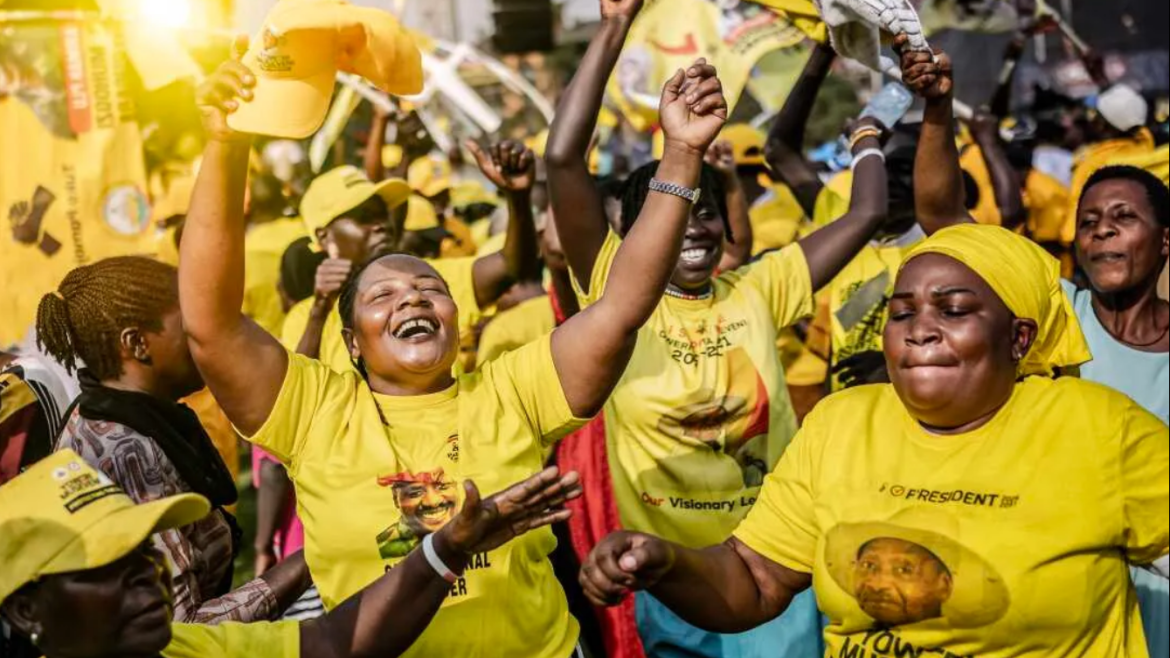 Supporters of Ugandan president Yoweri Museveni, age 81, celebrate his win in this month’s election. . / [link]Bruce Barron blog[/link]
Yesterday, I finally heard from my two contacts in Uganda.
Neither one of them had responded to my messages for a week. That was especially strange in one case, because I had just promised to send my friend some money.
He pastors a church in a Ugandan refugee camp of 130,000 people, and I had offered to buy him a speaker system so that he could do open-air preaching in the camp’s many villages.
All Evangelical Focus news and opinion, on your WhatsApp.
Nobody goes silent when offered money!
Well, it wasn’t his fault. The Ugandan government had shut down the Internet on January 13, two days before a presidential election. It also told two human rights groups to cease their activities. The stated reason was to prevent “misinformation, disinformation, electoral fraud and related risks.”
The election result was no surprise. Yoweri Museveni, 81, who has led Uganda since 1986, was declared the winner of a seventh term.
Few impartial observers consider the election free and fair. A September 2025 report accused the Museveni regime of “intensified authoritarianism” and “increasingly brazen disregard for democratic norms.”
It documented tight surveillance of civil-society organizations, abduction of opposition leaders, and harassment of journalists.
An observation group affiliated with the African Union also raised various concerns about the conduct of the election.
These problems may have worsened in the past few years, but they are not new. After the previous Ugandan presidential election in 2021, 54 religious and humanitarian groups operating in the country were suspended. They had allegedly supported the opposition candidate.
For those concerned about the path that the United States has followed in the past year, the pattern sounds all too familiar. Indeed, “intensified authoritarianism” and “increasingly brazen disregard for democratic norms” are phrases that could easily be applied to the US.
[destacate]Values are a matter of principle; tactical decisions are difficult, subjective judgments shaped by how one interprets the immediate context[/destacate]Ten years ago, not many US politicians would have said, “Of course, I will stand behind a political leader who threatens to invade Greenland because he did not win a Nobel Peace Prize.” But in 2026, that’s where we are and only a handful of legislators in the president’s party seem bothered.
What should Christians do in such situations? In Uganda, there is no easy answer, as speaking out carries significant risk and low chances of success.
Some Christians have expressed concerns; others stay out of the human rights lane and try to do their spiritual business.
In the US, I do not think I am personally at risk yet for expressing my opinion. However, that does not make the decisions any easier, as I was reminded when another Christian couple hosted us for lunch on Sunday.
The husband in this couple expressed his alarm about the Trump administration’s domestic enforcement actions and its attacks on opponents. But when I said electing the other party was the only way to stop these abuses, he said he didn’t like that option either.
He has retired recently from teaching at a Christian university that decided, a few years ago, to welcome openly gay faculty members. When my friend expressed opposition to the change, he says, he was effectively silenced by supporters of “diversity, equity, and inclusion” (DEI).
Despite his status as a tenured professor, he was denied the opportunity to give talks on campus or to participate meaningfully in university governance.
My friend views the Democratic party as supportive of such efforts to repress free speech in the name of DEI, and thus he does not view supporting Democrats as a viable alternative. He hopes instead that Republicans will distance themselves from Trump’s craziness.
I am not sanguine about the likelihood of Republicans coming to their senses, and I am more willing to select the more palatable of the two existing options.
I think the only way to limit Trump’s damage is to elect Democrats to a majority in the US Congress. I’ve already offered my support to a Democratic candidate for Congress in my city.
My friend and I have the same values but different tactics. Values are a matter of principle; tactical decisions are difficult, subjective judgments shaped by how one interprets the immediate context.
We will never agree fully on tactics, but we can all commit to determining our tactics based on our love for God and neighbor—in other words, based on our desire to see the gospel spread and suffering people helped.
Bruce Barron, author or coauthor of seven books on religion and politics and a former US congressional aide, was editor of the World Evangelical Alliance’s theology journal from 2018 to 2024. Subscribe to his blog at brucebarron.substack.com.






Las opiniones vertidas por nuestros colaboradores se realizan a nivel personal, pudiendo coincidir o no con la postura de la dirección de Protestante Digital.


Si quieres comentar o