


The latest cultural expressions of spirituality do not proclaim the gospel, but they prepare the ground. They are parables without end, open questions, altars to the ‘unknown God’.
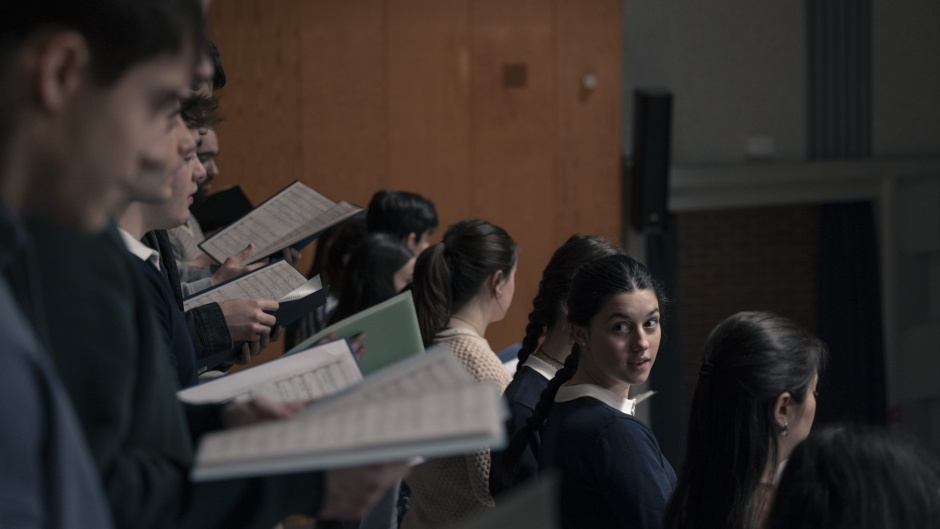 A scene of the acclaimed Spanish film Los Domingos (2025), about a young woman interested in becoming a nun.
There are times when culture is limited to entertainment and others when, without entirely intending to, it becomes a symptom. Ours clearly belongs to the latter.
In the midst of a society saturated with stimuli, exhausted by performance and distrustful of grand narratives, an ancient question re-emerges—in fragmentary, sometimes confusing ways: is there something more in life?
All Evangelical Focus news and opinion, on your WhatsApp.
The rise of the spiritual in contemporary creation is not a harmless fad, but a cry. A cry without fixed grammar, but recognisable nonetheless.
[destacate] The film Los Domingos depicts characters suspended in a liturgy of emptiness, where the ritual persists even though its meaning seems to have evaporated[/destacate]Rosalía's latest album, Lux, conveys symbols of light, purification and transcendence with a hybrid language: the sacred appears without dogma, mysticism without church.
In the book El loco de Dios en el fin del mundo (God's Madman at the End of the World), Javier Cercas approaches Christianity from a position of doubt, not to dismantle it, but to question it with radical honesty: what if God were precisely that which we cannot tame?
And the film Los Domingos (Sundays) depicts characters suspended in a liturgy of emptiness, where the ritual persists even though its meaning seems to have evaporated.
[destacate]Contemporary human beings live hyperconnected and yet radically alone; informed but not oriented; free but without direction[/destacate]We are not witnessing a return to faith, but rather the recognition of its absence. The spiritual reappears as an echo, as nostalgia, as hunger.
Modernity promised autonomy and meaning, but delivered fragmentation and exhaustion. Contemporary human beings live hyperconnected and yet radically alone; informed but not oriented; free but without direction.
In this desert, the spiritual becomes a language of resistance: a way of saying that life cannot be reduced to consumption, algorithms or productivity.
From a Christian perspective, this phenomenon deserves less suspicion and more discernment. Not every spirit is the Spirit, Scripture warns; but it also teaches that the Spirit blows where it wills.
These cultural expressions do not proclaim the gospel, but they prepare the ground. They are parables without end, open questions, altars to the ‘unknown God.’
They reveal a deeply biblical intuition: that human beings are made for transcendence and that nothing created can fulfil that desire.
[destacate]Here a bridge is built. Not to culturally colonise or moralise the search of others, but to offer the missing name.[/destacate]Here a bridge is built. Not to culturally colonise or moralise the search of others, but to offer — with humility and clarity — the missing name.
Christianity does not compete with these concerns: it fulfils them. In the face of a diffuse spirituality, the Gospel proposes a concrete God; in the face of the mysticism of the self, a God who becomes incarnate; in the face of light as an aesthetic symbol, a Light that enters history and traverses it with sacrificial love.
Christ does not cancel out the contemporary spiritual question: he takes it to its conclusion.
Why now? Perhaps because certainties have collapsed. Because progress no longer saves. Because technology does not respond to pain. Because death—which we thought had been banished—has come knocking at the door again.
In this context, spirituality reappears not as a luxury, but as a necessity. And here the Church has a decisive opportunity: not to shout louder, but to listen better; not to water down the message, but to embody it with beauty, truth and mercy.
When culture begins to speak of light, of God, of silence, of ritual, it is no coincidence. It is a sign that the soul, even when it cannot name it, continues to seek its home.
The Gospel does not come as an imposed answer, but as long-awaited good news. Where the world stammers, faith can speak. Where art asks, Christ answers. And not with an idea, but with a life.
[analysis]
[title]Join us to make EF sustainable[/title]
[photo][/photo]
[text]At Evangelical Focus, we have a sustainability challenge ahead. We invite you to join those across Europe and beyond who are committed with our mission. Together, we will ensure the continuity of Evangelical Focus and our Spanish partner Protestante Digital in 2025.
Learn all about our #TogetherInThisMission initiative here (English).
[/text][/analysis]





Las opiniones vertidas por nuestros colaboradores se realizan a nivel personal, pudiendo coincidir o no con la postura de la dirección de Protestante Digital.


Si quieres comentar o